What's Inside
- Why a Backyard Bird Journal Is Worth Keeping
- Choose a Journal Format You Will Actually Use
- Use a Simple Entry Template for Every Observation
- Look Beyond the Bird’s Name
- Build a Routine Around Real Backyard Moments
- Organize Notes So Patterns Become Visible
- Add Photos and Sketches Without Losing the Moment
- What Your Journal Can—and Cannot, Tell You
Why a Backyard Bird Journal Is Worth Keeping
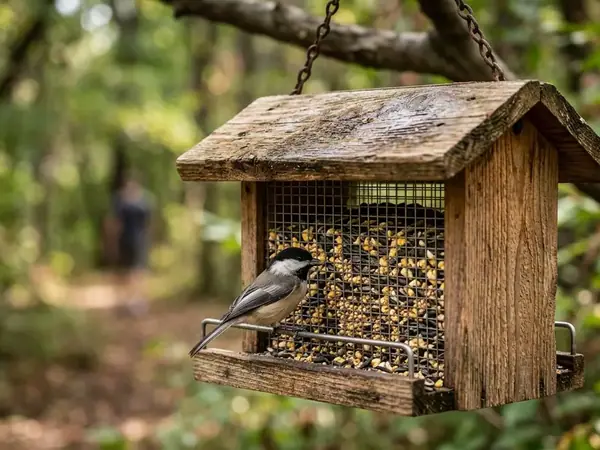
A chickadee lands on the same fence post three mornings in a row. It pauses, tilts its head, darts to the feeder, then carries one sunflower seed back toward the lilac hedge.
That is enough for a journal entry.
A backyard bird journal helps you slow down before the moment disappears. You do not need advanced birding skill to notice where a bird lands, what it eats, how the weather feels, or what question the sighting leaves behind. In fact, beginners often make excellent observers because they have not yet learned to rush past small details.
I like to start with first principles: a useful journal records what happened, where it happened, and what might be worth checking later. For a first week, aim for about 4 to 6 entries rather than a complete species list. A short observation window of roughly 5 to 12 minutes is long enough to catch behavior and short enough to repeat before work, school, or dinner.
Summary: Your first journal can stay simple. Track the bird, the place in the yard, the weather, the behavior, and one question to investigate later.
Choose a Journal Format You Will Actually Use
The best format is the one you can open at the viewing spot in under half a minute. If it takes hunting for a charger, finding a login, or redrawing a fancy page layout, the bird will usually win.
Paper notebook
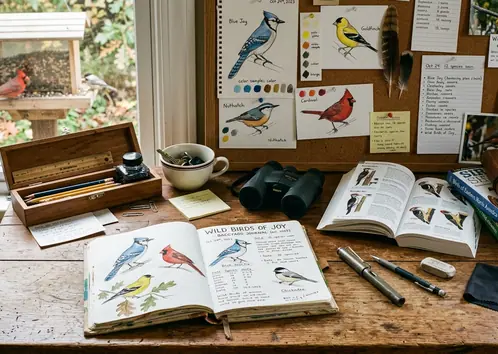
Paper works beautifully for families, sketches, and relaxed watching. Keep a pencil clipped to the cover. If you want to reduce fuss, mark the first several pages with simple date lines so nobody has to format an entry while a wren is bouncing through the shrubs.
Spreadsheet
A spreadsheet helps when you want to sort by date, species, feeder type, or yard area. Use one row per observation and plain columns: date, time, species or best guess, yard location, food source, weather, behavior, and notes.
Digital notes
Phone notes are handy for quick entries from a porch chair or window feeder. Create one pinned note titled “Backyard Birds” and add new entries in reverse order, with the newest note at the top.
Try one format for about three or four weeks before adding a second system. Switching between notebook, spreadsheet, and app during the first week can scatter observations and make monthly review harder than the watching itself.
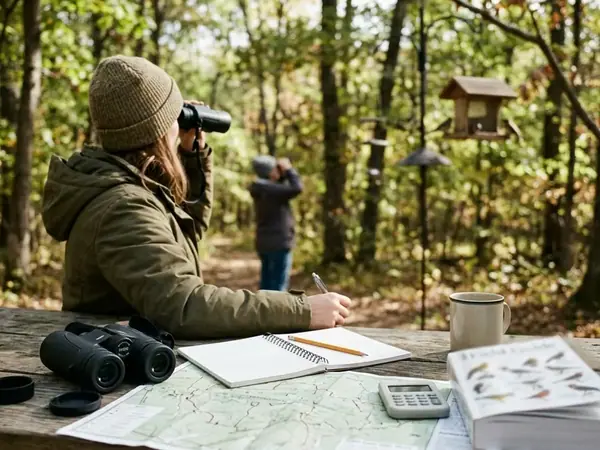
Quick Tip: If the journal lives outside, make a small kit: clipboard, pencil or weatherproof pen, and a zip-top bag for damp porch days.
Use a Simple Entry Template for Every Observation
A template protects you from blank-page thinking. It also helps you reconstruct the sighting later, especially when the bird was half-hidden, backlit, or gone in three seconds.
Backyard Bird Journal Entry Template
Simple fields for one backyard bird observation| Field | What to Write | Example |
|---|---|---|
| Date and time | Use the actual day and approximate time of the sighting. | May 14, 7:35 a.m. |
| Yard location | Name the exact home-scale spot. | Birdbath under maple |
| Weather | Record sky, wind, rain, snow, heat, or cold in plain language. | Cool, light rain just ended |
| Species or best guess | Write the name if known, or describe uncertainty honestly. | Possible female cardinal |
| Number seen | Count what you can see at one time. | 2 |
| Behavior | Describe what the bird did. | Took seed to lilac hedge |
| Food source | Note feeder, plant, ground, water, or unknown source. | Tube feeder with sunflower seed |
| Open notes | Add one question, sketch note, or sound description. | Sharp chip from shrub after landing |
Location can be as specific as north fence line, suet feeder, birdbath under maple, lilac hedge, window feeder, or leaf litter below oak. On a balcony, use tighter labels such as left rail or suction-cup feeder. In a larger yard, zones like back fence, native bed, and under maple may make more sense.
Honest uncertainty is not a weakness. Write “sparrow species,” “small gray bird with white eye ring,” or “woodpecker heard but not seen.” Cornell Lab of Ornithology’s eBird checklist guidance emphasizes careful location, date, effort, and honest uncertainty when observations are shared.
Look Beyond the Bird’s Name
A journal that records only species names may look tidy, but it will not explain why birds prefer the shrub side of the yard, why a feeder goes quiet after a hawk passes through, or why water use changes after dry weather.
Names matter. They are not the whole story.
Field marks worth writing down
- Body size compared with a familiar bird, such as a chickadee, robin, or crow
- Bill thickness, length, and shape
- Tail length and angle
- Wing bars, eye ring, or color patches
- Posture: upright, crouched, clinging, or horizontal
- Movement style: hops, walks, clings, swoops, or darts
Sounds in plain language
You do not need musical notation. “Sharp chip,” “two-note whistle,” “buzzy trill,” “soft chatter,” “rattle from shrub,” and “drumming on dead limb” are useful notes. They bring the observation back to life later.
Behavior tells the deeper story
Watch for birds taking seed to cover, chasing another bird from suet, bathing after rain, feeding on the ground below a feeder, carrying dry grass, or avoiding a feeder when a larger bird is present.
A strong entry might read: “Two chickadees took sunflower seed from the tube feeder to the lilac hedge; both returned within a few minutes.” Another: “Robin pulled worms from wet lawn after morning rain; stayed near the low spot by the path.”
Build a Routine Around Real Backyard Moments
A formal birding schedule sounds noble until Tuesday arrives with dishes, homework, work calls, and a feeder that needs cleaning. So attach your journal to a moment that already exists.
- 6 to 10 minutes during morning coffee
- 5 minutes after refilling feeders
- 8 to 15 minutes after school
- One quiet dusk check from the same window
Use the same seat or window for at least ten entries before comparing activity between yard areas. That consistency makes change easier to notice. If you watch from the kitchen window one day and the back steps the next, you may be measuring your own movement more than the birds’ behavior.
Family journals work best when the roles stay light. One person names the bird or best guess. One sketches the shape. Another records sky and wind. Someone else checks feeder level and cleanliness.
One careful sentence is enough: “Cardinal at north fence line, calling from dense shrub after feeder refill.” That is a real record.
Organize Notes So Patterns Become Visible
Organization should serve the birds, not the stationery aisle. Wait until you have a month of notes, then review what is already there.
Set aside roughly 15 to 25 minutes at the end of each month. Scan entries and mark repeated behaviors or new visitors. You are looking for patterns that can guide better care.
Simple tags to use
- FOS for first-of-season
- NEST for nesting behavior
- NEW for a new yard visitor
- WATER for birdbath use
- CONFLICT for feeder chasing
- WX for unusual weather
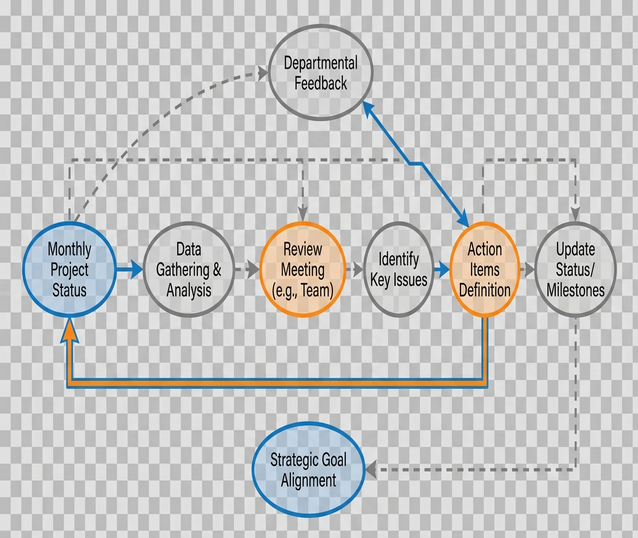
Review by month, species or best guess, feeder type, water use, weather condition, and yard area. From forum discussions, the most useful patterns often come from ordinary repetition: birdbath use during dry spells, ground-feeding birds gathering below a messy feeder, or dense shrubs acting as escape cover after feeder visits.
From there, choose one practical adjustment. Move a feeder closer to natural cover while keeping visibility. Add a shallow water source. Leave seed heads standing longer. Plant native shrubs where birds already pause.
Add Photos and Sketches Without Losing the Moment
Photos can support identification, especially for fleeting details like wing bars, bill shape, or tail pattern. They do not need to become the whole activity.
Instead of printing every image, write a reference in the journal: “photo in phone album, Tue 7:40 a.m., feeder close-up.” That is usually enough to find it again.
Sketches are just as useful, even imperfect ones. Give yourself half a minute or so. Capture body shape, bill length, tail angle, and any obvious wing bar or eye mark. A crooked sketch of posture can be more helpful than a blurry photo of leaves.
Note: Do not walk toward a bird until it flushes, crowd a nest, use loud playback near the yard, trim cover for a cleaner photo, or keep opening a door near a nervous feeder bird.
Your journal can also support responsible feeding. Record food type, feeder fill date, visible hull buildup, damp seed, dirty water, and any bird that appears lethargic, fluffed, crusted around the eyes, or unusually easy to approach.
What Your Journal Can—and Cannot, Tell You
A backyard journal can reveal patterns in one yard. It cannot, by itself, prove broad population changes, regional migration timing, or conservation trends. That boundary matters because careful notes are valuable, but one household view is still one household view.
Several things can bend the record: vacation days, changed work schedules, feeder removal, a new seed mix, snow cover, heat, rain, pruning, nearby construction, or a neighbor adding feeders. Even enthusiasm can skew the notebook if entries happen only on exciting bird days.
Before treating the journal as a useful household data source, look for the same general viewing location, a similar observation window, and entries made across several weeks. The aim is not perfection. It is honest continuity.
Start today with one short entry. Review after about a month. Circle repeated yard locations. Then choose one habitat or feeder-care improvement from the notes.
That is how a backyard journal grows: one perch, one weather note, one question, one small act of care.