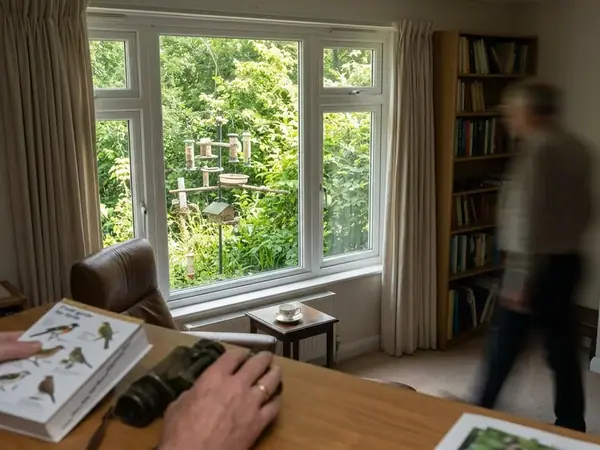
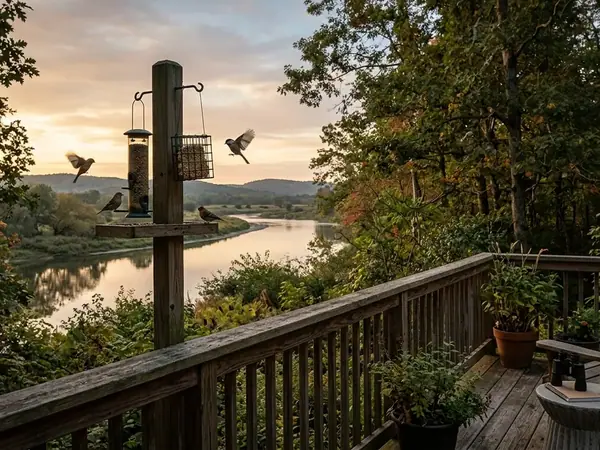
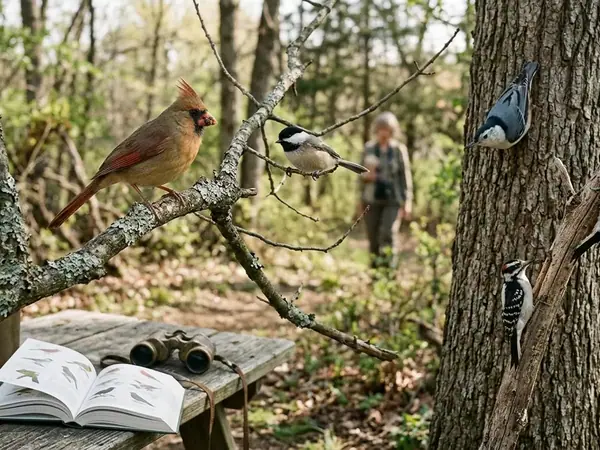
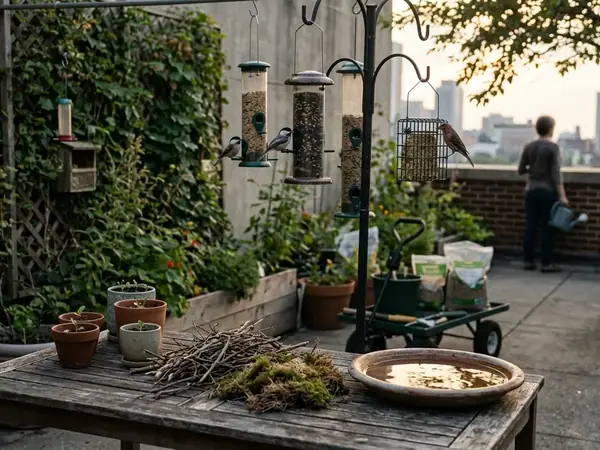
Window birdwatching starts in ordinary places: a kitchen table pulled six to twelve feet back from feeder glass, a living-room chair aimed at a patio door, or a windowsill tray close enough that a chickadee seems to land in the room. The access is wonderful. It is also easy to mishandle.
The goal is not to become invisible. Birds do not need a perfect vanishing act from the household. They need the room behind the glass to become predictable, quiet in its movements, and less visually sharp.
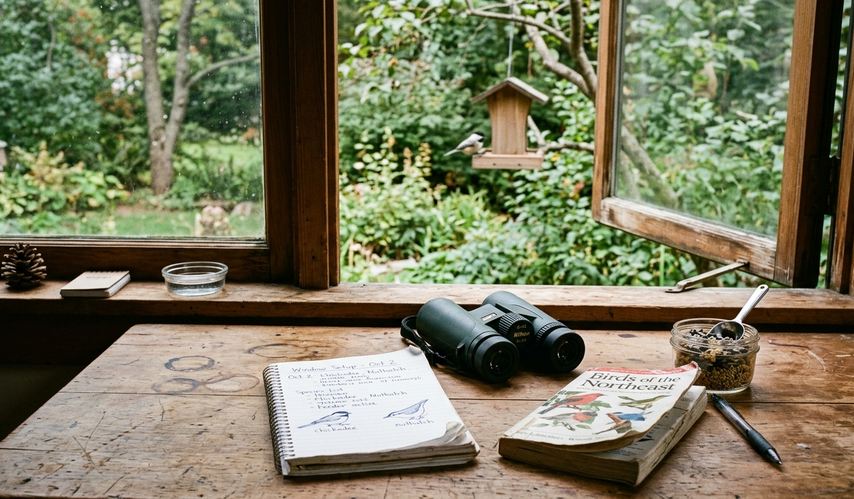
How the Window Became a Backyard Bird Blind
Picture windows and patio doors changed backyard birdwatching more than most field guides admit. A person no longer has to hike to a hide or crouch behind shrubs. The blind is already built into the house.
That convenience brings birds unusually close. A goldfinch at a feeder beyond the kitchen glass, a nuthatch on a suet cage outside the patio door, a titmouse on a suction-cup tray: each one gives the watcher a clear look at bird identification and behavior without leaving breakfast behind.
Glass, though, is not neutral. It throws reflections. It frames indoor movement. It can turn a face into a sudden pale shape near the pane or make a lamp-lit room stand out at dusk. Success should be measured by what the bird actually does: feeding, preening, scanning briefly, changing perches, and leaving without being flushed.
The practical aim
Watch longer by becoming part of the background. A seated person six feet back from the window may disturb less than a quiet person who suddenly leans nose-first into the glass.
What Birds Are Likely to Notice at Your Window
Birds do not need to read the room. They react to cues.
The strongest indoor disturbances usually involve fast side-to-side movement within a foot or two of the pane, a face moving directly toward the glass, or a hand, phone, or binoculars lifting suddenly into the window area. A bird may not understand the object, but it can register the abrupt change.
Watch the bird, not the story in your head. Mild alertness often looks like stopping with seed in the bill, standing taller than during normal feeding, repeated head turns toward the room, one or two quick wing flicks, or leaving the feeder and returning within a minute or two.
A chickadee or titmouse that visits a feeder many times a morning may tolerate a seated observer better than a migrant warbler using the same shrubs for a brief stopover. Weather, season, predator pressure, and past experience all change the glass effect. Bright mornings with a darker room behind the window can make outdoor reflections dominate. Near dusk, lamps may make the person indoors easier to see.
Note: Do not treat a calm bird as permission to crowd the pane. Mild alert signs are useful because they appear before a full flush.
Control the Light Before You Control Your Movement
Light often exposes the watcher before movement does. A still person can become obvious if the room is bright behind them or if a lamp creates a clean head-and-shoulder outline against the glass.
Start small. Turn off the lamp closest to the window and observe from the dimmer side of the room for one feeding period. Do not rearrange the whole room on the first morning. One change gives cleaner feedback.
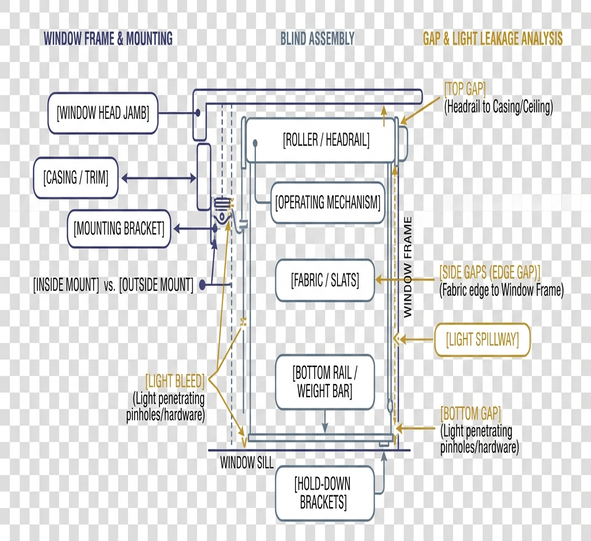
A side viewing gap of roughly three to six inches is often enough for one seated observer while still breaking up the full outline of the body. Partial blinds can do similar work. Angle the slats so daylight enters while shoulder and arm movement sit behind horizontal bands.
Light control is not collision prevention
A window that feels perfect for observation can still be unsafe for birds if the exterior reflects sky, trees, or open flight paths. The U.S. Fish and Wildlife Service guidance on preventing bird-window strikes emphasizes visible exterior treatments such as screens, netting, decals, tape, and other markers. Indoor dimming helps the watcher behave less like a bright moving shape; it does not replace bird-safe exterior treatment.
Move Like Part of the Room, Not Like a Visitor at the Glass
The classic disruption is easy to picture. Someone spots a bright bird, crosses the room quickly, points at the pane, and raises a phone in one abrupt motion. The bird leaves. The person blames the glass.
The better setup starts earlier. Put the chair four to eight feet back from the window. Place binoculars, camera, notebook, and a drink within reach. Then settle before the feeder gets busy.
Once birds begin feeding or preening, keep movements small and slow. Raise binoculars from below chest height rather than snapping them up into the window area. Turn your head before moving your shoulders. If a bird looks toward the room and pauses, stop. Let it decide whether the movement matters.
Children do better with a concrete rule. Mark a quiet viewing spot with a cushion or small chair before feeder activity starts. The instruction becomes simple: go to the bird seat, not to the glass.
Use Curtains and Blinds as Soft Cover
Soft cover is not about hiding in a dark cave. It is about softening the indoor shape enough that normal household presence does not read as a sudden approach.
Curtains for seated observation
Pull one panel across most of the pane and leave a narrow side gap just wide enough for eyes and binocular barrels. This works well for a single seated watcher who plans to stay in place. The bird sees a consistent partial shape instead of a full person appearing and disappearing.
Angled blinds for bright rooms
In a room that catches strong daylight, blinds can be more useful than heavy fabric. Angle the slats so outdoor light comes in from above or below while the observer’s torso and arm motion break into small horizontal bands.
Sheers for household traffic
Sheer fabric earns its keep in rooms where people pass behind the window. It softens silhouettes without shutting down the room. That matters in real houses, where a feeder window may also be near the sink, the sofa, or the back door.
Summary: Birds often react less to a consistent partial shape than to a new, fast-moving human outline. One catch: if the same window is also a known strike spot, a comfortable viewing gap should not replace exterior bird-safe treatments.
Keep Your Viewing Routine Predictable
Birds near homes often adjust to repeated, non-threatening patterns. They learn the rhythm of doors, refills, and the person who sits in the same chair every morning. Irregular rushes to the window can reset that caution.
Choose one regular viewing chair. Keep binoculars or a camera on the same side table, not across the room. The less scrambling the watcher does after a bird lands, the more natural the viewing session becomes.
Feeder care and safety fits into the same pattern. Refill, rinse or wipe the tray when needed, step back indoors, and avoid standing at the glass to see who returns first. A useful maintenance window is after the main morning rush or before late-afternoon activity, rather than during the busiest cluster of visits.
A room that is calm at sunrise may become more disruptive after lamps turn on near dusk. If the evening watch suddenly feels jumpier, check the lighting before blaming the birds.
When the Bird Is Right on the Window Feeder
Close-range feeders are the most sensitive version of window birdwatching. With suction-cup feeders and windowsill trays, the bird may feed within inches of the glass. At that distance, a tapping finger or phone pressed close to the pane can become the dominant cue.
Shrink the observer’s role. Sit first. Keep hands away from the pane. Let the feeder do the inviting. Do not tap, call, wave, or try to coax the bird closer for a better photo.
If birds scatter whenever the room becomes active, change one element during the next session. Move the chair farther back, narrow the curtain gap, or route household foot traffic behind the observer instead of across the window. Change only one thing, or the lesson gets muddy.
Quick Tip: Keep a small notebook beside the viewing chair. Record three columns: indoor action, bird response, and whether the bird resumed feeding.
Run a Quiet-Window Trial on Your Next Active Morning
Use one active window as the test site. Set it up fifteen to thirty minutes before the usual morning feeding period, while the room is still yours and not yet full of bird arrivals.
- Pick one window with regular bird activity.
- Set the chair before birds arrive.
- Dim the room slightly or turn off the lamp nearest the glass.
- Create one narrow curtain gap or angle the blinds.
- Place binoculars, camera, notebook, and drink within reach.
- Sit in the chosen chair and keep both hands below the windowsill line when birds first arrive.
Track three things: whether birds stay on the feeder, whether they resume feeding after looking toward the glass, and which indoor movement interrupts feeding or scanning. Do not chase every variable at once.
On the following active morning, change one specific detail: chair distance, curtain gap width, blind angle, or the route people take through the room. Make the adjustment before the birds arrive, then sit down and let the window become quiet. By the third or fourth morning, you will likely know which single change bought you the longest, calmest look — and that becomes your default setup.