What's Inside
- Start with shape before reaching for a name
- Read size, posture, and silhouette
- Use bills, tails, and wings as clues
- Watch movement on the ground, branches, and feeders
- Identify flight style and landing behavior
- Let the yard setting narrow the possibilities
- Recognize common mistakes and limits
- Use a repeatable 30-second routine
Start With the Bird’s Shape Before Reaching for a Name
A backyard bird rarely waits for a complete inspection. It crosses a kitchen window, lands on a feeder hook, slips through a hedge gap, or stands at the lawn edge for only a few seconds. In those short sightings, often just a few seconds, color often arrives too late to be useful.
Shape arrives first.
Backlighting at sunrise can turn a bright bird into a dark cutout. Glare on window glass can wash out wing bars. Shade under shrubs can flatten every brown and gray into one tone. Leaves, feeder baffles, and window frames often hide the very markings a field guide asks a beginner to check.
The practical order is therefore simple: identify the bird first by overall silhouette, posture, size, movement, and behavior. Use color and markings last, as confirmation rather than as the first guess.
This method fits ordinary home watching: families at a kitchen table, homeowners checking a seed feeder, beginners watching shrubs, fences, lawns, patios, and window feeders. It does not require rare-bird expertise. It asks for a calmer first look.
Read the First Impression: Size, Posture, and Silhouette
Use a reference bird, not a ruler
Estimating inches through glass is a poor habit. A bird on a far fence rail looks smaller than the same bird on a nearby feeder. Instead, pause for a moment and place the bird on a familiar backyard ladder: sparrow-sized, robin-sized, pigeon-sized, or crow-sized.
That one decision removes many unlikely choices before color enters the conversation.
A compact bird at a seed feeder may sit in the sparrow-to-finch range. A longer bird standing on open lawn may feel robin-sized. A plump bird on a fence rail may read dove-like. A heavy dark bird on a roofline may belong near the crow-sized end of the ladder.
Sort posture into broad buckets
Posture usually holds longer than color. Four buckets work well in the yard:
- Upright and alert: often seen in robin-like lawn birds that pause, scan, and then move again.
- Horizontal and streamlined: common in birds that lean forward along branches or move with a low profile.
- Hunched and compact: frequent at feeders, especially when birds pause between seed handling.
- Round-bodied and close to the ground: useful for plump birds feeding, resting, or walking with short steps.
Silhouette then sharpens the first impression. Finches often appear compact with conical bills. Robins look longer-bodied and more upright. Woodpeckers cling vertically to trunks, poles, and suet feeders. Doves carry a plump body with a comparatively small head.
Quick Tip: For the first look, say the size and posture aloud: “robin-sized, upright,” or “sparrow-sized, compact.” A plain label is better than a rushed name.
Use Bills, Tails, and Wings as Built-In Identification Clues
Start with the bill
The bill is often the easiest small feature to judge at rest. It does not need measurement. It needs a category.
- Short cone: suggests seed handling, especially at feeders or seed-bearing plants.
- Thin pointed bill: often suits birds picking insects from leaves, bark, or open ground.
- Chisel-like bill: supports woodpecker-like behavior when paired with vertical clinging.
- Long probing bill: may fit nectar feeding, mud probing, or bark probing depending on the setting.
- Small straight bill: can appear on many perching birds and needs support from posture and movement.
No single bill shape should carry the whole identification. A slender bill near flowers means something different from a slender bill working bark crevices.
Read tail and wing outline as supporting evidence
Tails often announce balance. Long tails help wrens and mockingbird-like birds pivot, cock, and steady themselves. Woodpeckers may press stiff tails against bark as a brace. Many perching birds spread the tail briefly like a fan when landing, turning, or balancing.
From a window, watch whether the tail is cocked upward, held level, flicked downward, spread briefly, or pressed firmly against a trunk.
Wings are harder at rest, but the outline still matters. Rounded wings can make a bird look compact and ready for quick takeoff in shrubs. Long wing tips lengthen the body line. Pointed wings can suggest faster open-air movement, while shorter rounded wings often fit cluttered spaces where sharp turns matter.
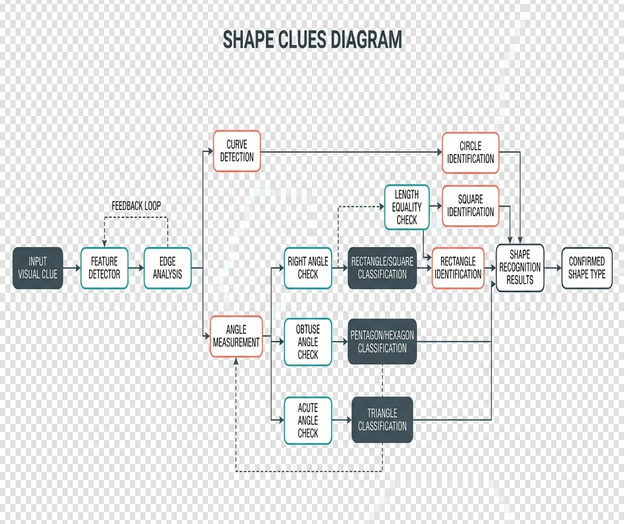
During practice, a useful notebook exercise is to draw only the outline in half a minute or so: body oval, head size, bill length, tail length, and whether the wings look short, rounded, or long-tipped. The drawing can be crude. The act of choosing the outline builds the skill.
Watch How the Bird Moves on the Ground, Branches, and Feeders
Match movement to the surface
Movement makes the most sense when tied to where the bird is standing. A lawn, feeder rim, tree trunk, and hedge branch each invite different behavior.
On lawns, robin-like foragers often use a run-pause-run pattern. They move, stop, tilt or scan, then move again. Many sparrow-like birds instead use short hops with scratching or pecking, especially near leaf litter, garden edges, or spilled seed.
On trunks and poles, vertical movement becomes valuable. Woodpeckers climb upward and brace against the surface. Nuthatch-like birds may move headfirst down bark. Creeper-like birds stay tight to the bark and progress in short increments.
Feeder behavior is a short performance
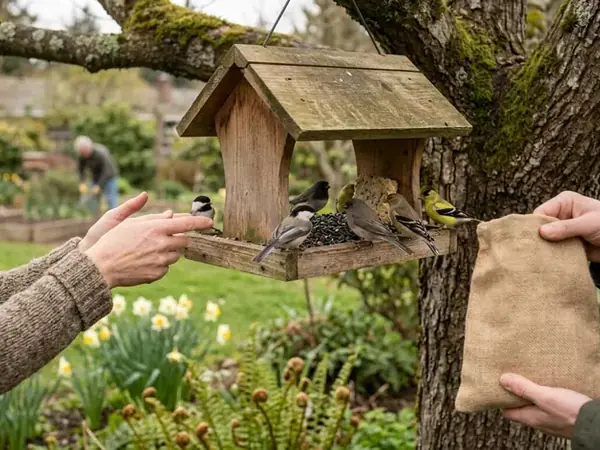
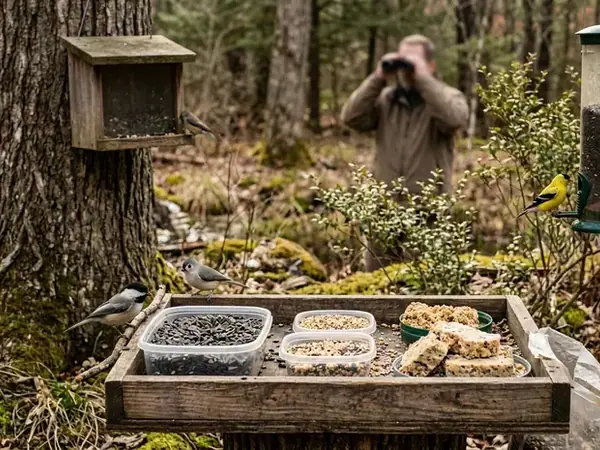
A feeder visit may last only a few seconds, but it can say a great deal. One bird perches and shells seeds. Another clings briefly, takes one item, and leaves. A third waits on a nearby twig before entering. A bolder visitor may displace another bird without feeding at all.
Community observation suggests that beginners learn faster when they watch the whole feeder sequence instead of staring only at color patches. Arrival, handling, posture, and departure all belong to the clue set.
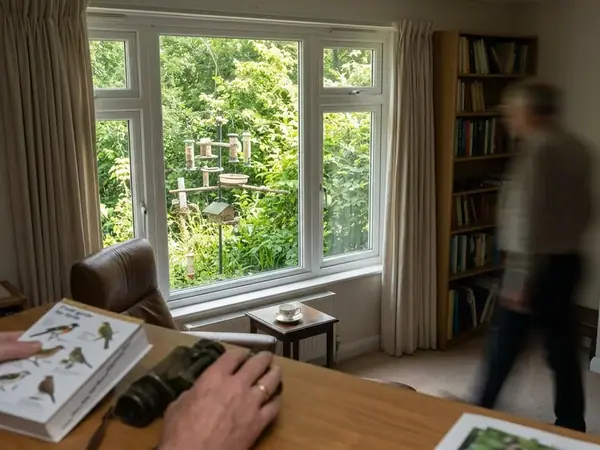
Note: Watch from indoors, a porch chair, or a still spot several paces away. Tapping glass, waving, or stepping toward the feeder forces behavior and makes the clue less reliable.
Identify Flight Style: Direct, Bouncy, Gliding, or Undulating
Name the path before the species
Flight looks chaotic until it has a vocabulary. In a backyard, useful flight categories include direct, bouncy, flap-and-glide, swooping, hovering, and short low bursts between cover points.
A direct flight looks straight and purposeful. A bouncy flight rises and dips with quick wingbeats. Flap-and-glide alternates effort with short pauses. Swooping flight curves through space. Hovering holds position briefly. A short low burst often connects shrub to shrub, feeder to hedge, or lawn to cover.
Body shape helps explain the path. Rounded wings suit quick takeoffs in cluttered shrubs. Long pointed wings fit faster movement through open air. Broad wings can make gliding more visible.
Do not ignore the landing
Many beginners miss the bird in the air but still catch the endpoint. That endpoint matters: lawn, suet cage, seed feeder rim, trunk, roofline, overhead wire, fence rail, shrub interior, or birdbath edge.
Finches may look bounding between trees. Doves often launch with loud wingbeats. Many woodpeckers show an undulating path between trees or poles. These are cautious examples, not rigid rules.
Watch one complete movement from takeoff to landing before opening a guide. In a small yard, that usually takes just a few seconds.
Let the Yard Setting Narrow the Possibilities
Microhabitat changes the meaning of a clue
A backyard is not one habitat. It is a set of small zones: open lawn, dense hedge, seed feeder, suet feeder, tree trunk, fence rail, birdbath, roofline, window feeder, brush pile, and garden bed.
The same shape clue can point in different directions depending on the zone. A slender bill hovering near flowers suggests one feeding context. A slender bill probing bark suggests another. A slender bill picking at wet soil after rain belongs to yet another scene.
Feeding motions refine the picture. Watch for cracking seeds at a feeder, probing soft soil, picking insects from bark crevices, sipping nectar at flowers or a nectar feeder, bathing with wing flicks, preening on a safe perch, or scanning quietly before dropping to the ground.
Make the yard easier to read
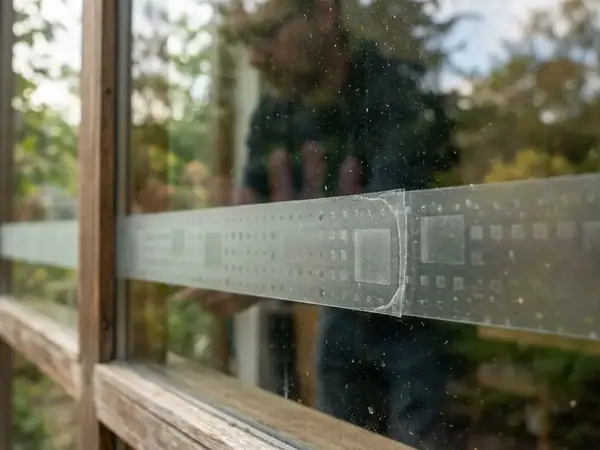
Bird-friendly conditions also make behavior more natural. Clean water refreshed regularly encourages bathing and drinking. Feeders placed near escape cover, but not in direct window-collision danger, let birds use ordinary approach routes. Native shrubs and seed-bearing plants give birds places to forage, shelter, and reveal repeated patterns.
This article focuses on common backyard visitors and repeatable visual behavior, not rare-vagrant confirmation, banding-level details, or formal survey protocols.
Summary: Location does not name the bird by itself. It tells the observer which shape and movement clues deserve more weight.
Common Mistakes: When Shape and Movement Can Mislead You
Some shapes are temporary
Shape-and-movement identification is strongest for common local backyard birds seen behaving naturally; it is much weaker for distant flyovers, storm-blown rarities, injured birds, and birds seen only as a single blurred silhouette.
Ordinary yards create distortions. Juvenile proportions can make a familiar bird look odd. Molting gaps in wings or tail can change the outline. Wet feathers after rain or bathing can slim the body. Puffed winter posture can make a bird look rounder and shorter than usual. Leaves, feeder ports, and window frames can hide the very part needed for a clean read.
A wet dove on a cold fence rail may look slimmer and darker than expected, so the plump silhouette clue can fail until the bird dries and relaxes.
Movement can change under pressure
Behavior is not fixed. Wind can cause balance shifts. Cold can make birds sit puffed and still. Predator presence can cause sudden freezes or alarm flights. Feeder competition can make normally calm birds dart in and out.
A sparrow startled by a hawk shadow may fly in a straight emergency burst rather than its usual short hops and low cover-to-cover movements. A juvenile robin on a lawn can appear spotty, compact, and uncertain in movement, which may tempt beginners to treat it as a different kind of bird.
Leave room for uncertainty. Labels such as unknown sparrow, woodpecker-like bird, small gray bird, robin-sized ground forager, or brown bird with long tail preserve useful information without forcing a name.
Do not chase, flush, corner, whistle aggressively, or bait a bird just to confirm a backyard identification. The better observation is the one the bird gives freely.
A Repeatable 30-Second Backyard Bird ID Routine
Use the same order each time
The most reliable routine puts large clues first and color last. It works because the bird may leave before the full view appears.
- 0-3 seconds: Compare size to a familiar bird: sparrow, robin, pigeon, or crow.
- 3-7 seconds: Name the silhouette and posture: compact, upright, horizontal, plump, clinging, or ground-hugging.
- 7-12 seconds: Check the bill category: short cone, thin pointed, chisel-like, long probing, or small straight.
- 12-16 seconds: Note the tail: long, short, cocked, level, flicked, fanned, or braced against bark.
- 16-21 seconds: Watch movement: hopping, walking, creeping, clinging, bobbing, tail-flicking, or running and pausing.
- 21-25 seconds: Record the location: lawn, hedge, feeder, trunk, fence, roofline, birdbath, garden bed, or window feeder.
- 25-28 seconds: Identify the feeding action, if visible: cracking, probing, picking, sipping, bathing, preening, or scanning.
- 28-30 seconds: Use color or markings as confirmation, not as the first guess.
Keep a modest log
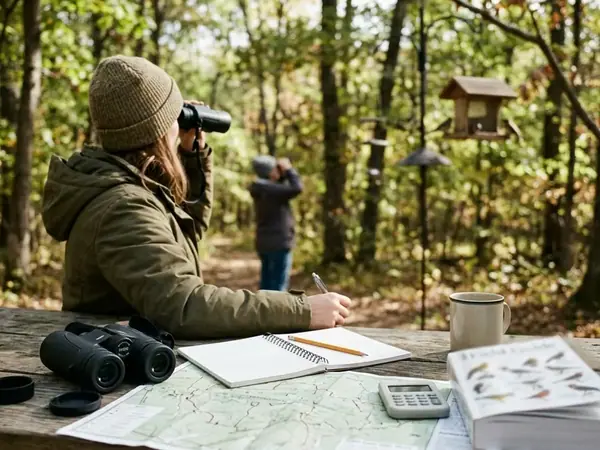
A simple observation log turns scattered sightings into field notes. Record the date, time of day, weather, yard location, perch or surface, movement, feeding action, color checked last, and confidence level.
Repeat observations at the same spot during at least two daily windows, such as early morning activity and late-afternoon feeder visits. Regular birds and their routes become easier to recognize when the observer keeps the place constant.
The practical sequence holds: shape gives the first clue, movement confirms the group, behavior narrows the answer, and color works best at the end.