What's Inside
- Start by Listening Before You Look
- What Backyard Birds Are Usually Saying
- Set Up a Five-Minute Listening Station
- The Five Clues That Narrow a Call Fast
- Common Backyard Call Patterns to Learn First
- A Beginner’s Routine for Naming the Caller
- Listen Without Disturbing the Birds
- When a Call Is Not Enough for a Confident ID
- Seven-Day Practice Plan
Start by Listening Before You Look
The sound usually arrives first.
A beginner may stand at a porch rail, kitchen window, balcony edge, or feeder pole and hear a sharp note from somewhere a few meters away. The bird stays hidden in privet, arborvitae, fence shadows, gutter lines, or feeder traffic. By the time binoculars come up, the movement has already slipped behind leaves.
That is normal backyard birding, not a sign of poor skill. Calls work best when treated as practical clues rather than a memorization test. The first useful observations are not rare species names. They are direction, height, rhythm, repeat count, and whether the bird is feeding, perched, chasing, or flying.
This guide keeps the scope local and usable. It builds a listening routine for common backyard situations: feeders, shrubs, fences, rooflines, brush piles, and the quiet hour before sunset. It does not attempt an exhaustive regional sound catalog.
What Backyard Birds Are Usually Saying
Beginners often call every bird sound a song. In the field, the difference matters because songs and calls tend to appear in different moments.
Songs are often longer and more public
A song is usually a longer phrase, often linked with territory or mating behavior. Many birds deliver songs from exposed perches: a roof peak, utility wire, treetop, or fence line. The bird seems to want the sound to carry.
Mourning Doves, for example, may give low, rounded coos from a wire or roof edge. A cardinal-type whistle may come from a visible branch or fence top. Woodpeckers may not sing in the same way, but their drumming on a hollow limb, metal cap, or resonant siding can function as a loud territorial signal.
Calls are shorter and more situational
Calls often do practical work. They keep birds in contact, warn others, coordinate movement, signal begging, or mark a quick overhead flight.
- A chickadee may give buzzy warning chatter near a dense shrub.
- A Blue Jay may send a harsh call from a tall tree when something below looks wrong.
- Fledglings may beg from cover while adults move nearby with food.
- Small birds moving through shrubs may trade brief contact notes that last only a few seconds.
Note: A scolding chorus near a feeder does not point to one cause by itself. A hawk, cat, snake, squirrel, person near nesting cover, or one agitated bird triggering others nearby can all create the same urgent atmosphere.
Set Up a Five-Minute Listening Station
Beginners learn faster when the yard stays constant and only the sounds change. Choose one fixed seat and return to it for at least a week of consecutive days.
1. Rhythm
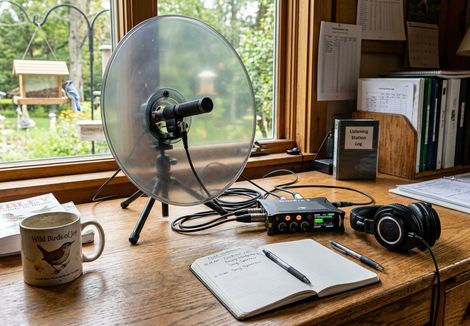
The station can be a porch step, feeder-facing chair, balcony corner, open kitchen window, or garden bench. The session lasts about 5 minutes. That is long enough to catch repeated patterns and short enough to repeat before work, after dinner, or while the kettle warms.
Keep the kit plain
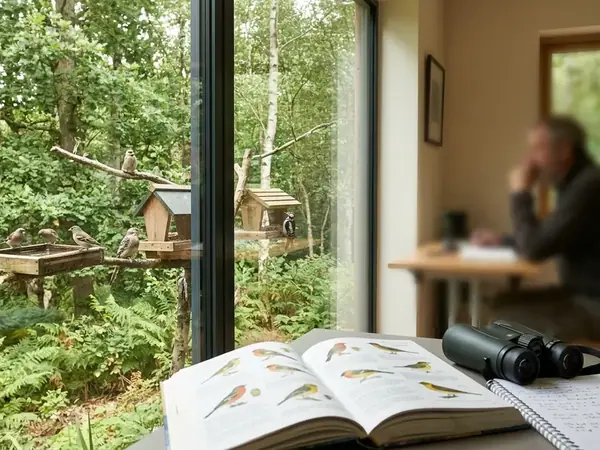
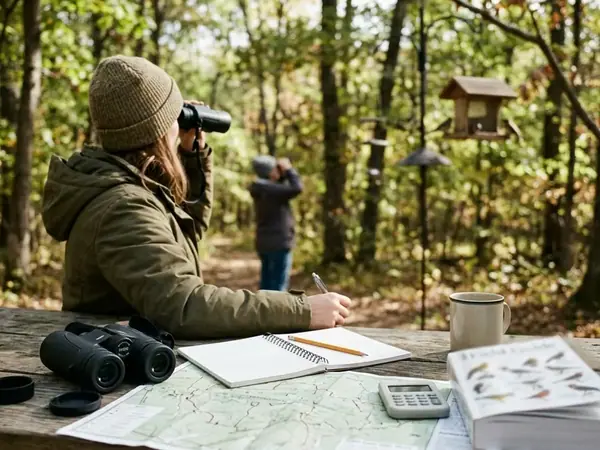
- Pocket notebook
- Pencil
- Binoculars
- Phone recorder kept in quiet mode
- One field guide or bird ID app, used after notes are written
Consistent times help. Early morning often has more vocal activity in many yards, and the quieter hour before sunset can reveal calls that disappear under daytime noise. Still, the point is not to chase a perfect hour. The point is to compare like with like.
Use a simple listening log
A useful log records the conditions around the sound, not just the sound itself.
- Date and time
- Listening spot
- Weather in plain words
- Direction of sound
- Height or perch area
- Habitat feature
- Sound description
- Behavior seen
- Confidence level
- Follow-up comparison
A strong beginner note can stay humble: 6:42 a.m., cool, light breeze, north fence, low lilac, chip-chip-chip, bird flicking tail, not seen well.
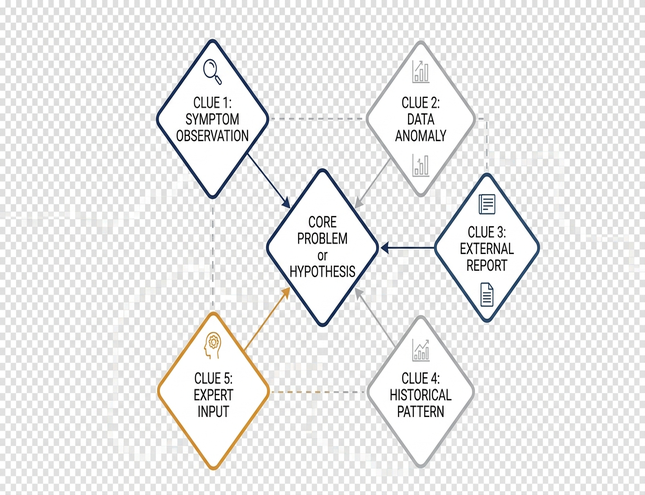
The Five Clues That Narrow a Call Fast
A beginner does not need to know bird anatomy before listening well. The most useful clues move from what the ear catches first to what the eyes can confirm afterward.
Ask what the sound does over time. It may be a single note, paired note, repeated phrase, loose chatter, fast trill, slow cooing, or irregular scold. Rhythm is often more useful than spelling the sound perfectly.
2. Pitch and tone
Use plain words: thin, sweet, buzzy, nasal, raspy, whistled, metallic, hollow, squeaky, or dry. These words feel imprecise at first, but they train the ear to notice texture.
3. Direction and height
A sharp chip from the hedge should not become a species name too quickly. The better clue is whether the sound comes from ground cover, a shrub interior, feeder level, an exposed perch, the roofline, a chimney, treetop, or an overhead flight path.
4. Behavior
Watch for feeding, chasing, mobbing, still perching, carrying nesting material, visiting water, wing-flicking, tail-pumping, or calling while flying. A bird giving chips while hidden in winter weeds presents a different problem from a bird whistling from a bare branch.
5. Repetition
Count loosely. Does the sound happen once, in pairs, in short runs of several notes, or in a longer burst? Does it change when a person, cat, hawk, or squirrel moves through the yard? Repetition turns a stray noise into a pattern.
Common Backyard Call Patterns to Learn First
Arranging sounds by bird family looks tidy on paper. It is less helpful at a window. A listener does not hear taxonomy first; the ear catches chips, whistles, scolds, coos, buzzes, and scratches.
Sharp chips and ticks
These often come from brush piles, hedge bases, winter weeds, fence corners, and low shrubs. Sparrows, cardinals, juncos, and similar small birds may stay partly hidden while giving these clipped notes.
The working question is not, Which sparrow is that? The first question is, Where is the chip placed in the yard? Ground and leaf litter suggest one search pattern. Shrub interior suggests another.
Harsh scolds and alarms
Harsh scolds usually come with visible agitation. Look for repeated hops, raised posture, tail jerks, or birds gathering around a threat. Jays, wrens, chickadees, robins, and blackbirds can all sound forceful when reacting to a cat, hawk, owl, snake, or person near nesting cover.
Soft coos and low notes
A Mourning Dove-type rhythm is slow, rounded, and low. It often comes from a wire, roof edge, bare branch, or open lawn edge. The sound can seem farther away than the bird actually is because it lacks a sharp edge.
Clear whistles and paired phrases
Northern Cardinal-style phrases are familiar in many North American yards: clear, whistled, and often repeated from a visible perch. Regional differences matter, so the pattern should be treated as a clue rather than a final label.
Buzzes, trills, and chatter
For wrens, finches, chickadees, and other active feeder-edge birds, energy and pace matter more than syllable-perfect spelling. A fast trill from a shrub edge and loose chatter near a feeder ask for different follow-up scans.
A Beginner’s Routine for Naming the Caller
The first mistake is walking toward the sound. That movement often flushes the bird and removes the best evidence.
- Freeze and listen. For the first 10 to 20 seconds after hearing a new call, stay still. Let the full pattern repeat if the bird offers it.
- Mark the direction. Anchor the sound to a fixed object: left side of the maple branch, top rail of the fence, back gutter, birdbath rim, feeder pole, chimney cap, or tomato cage.
- Scan by likely height. Start where the sound fits: ground for scratching sounds, shrub layer for chips, feeder level for contact notes, roofline for whistles or coos, and sky for flight calls.
- Compare body size. Use familiar references: smaller than a House Sparrow, robin-sized, jay-sized, dove-shaped, woodpecker posture on a trunk, or finch-like on a feeder.
- Check after writing. Compare with a recording library or bird ID app only after writing the description, direction, and behavior notes.
For many readers, Cornell Lab’s Merlin Bird ID can be useful at this final comparison stage. It should not replace the first round of listening. Notes made before checking an app tend to be more honest.
Quick Tip: If the bird vanishes before a clear view, keep the note. A possible call with good location and behavior detail teaches more than a forced name.
Listen Without Disturbing the Birds
Good listening does not need to provoke a response.
Avoid repeated outdoor playback, especially within sight of nest boxes, dense nesting shrubs, porch beams, hanging baskets, or cavities where birds are carrying food or nesting material. Playback can pull birds away from feeding, resting, guarding territories, or caring for young.
If a bird approaches closely, scolds continuously, raises its crest, flicks its wings, or circles the same shrub, step back. Stop trying to draw another response. The bird has already given enough information.
Better replacement habits
- Listen passively from the chosen station.
- Write the sound and behavior before comparing recordings.
- Use recordings indoors after the bird has moved on.
- Keep phone volume low enough that it cannot be heard through an open window.
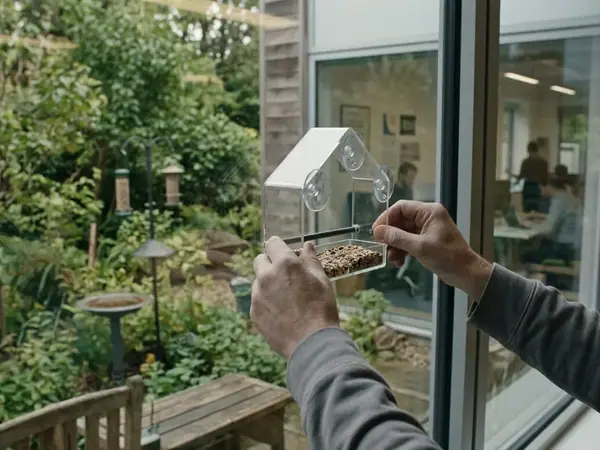
Responsible listening fits with other bird-friendly home choices. Keep cats indoors or directly supervised. Place feeders where window collision risk is reduced. Break up glass reflections. Delay trimming shrubs that show active nesting behavior.
When a Call Is Not Enough for a Confident ID
Uncertainty is part of good birding. It is not a failure.
Sound identification can be uncertain for beginners and experienced listeners, especially in noisy neighborhoods with close houses, hard siding, alleys, or heavy traffic; the apparent direction of a call can be wrong by a fence line or even an entire yard.
Common sources of error include two species calling at once, juvenile begging calls, mimicry, mower or traffic noise, echoes between nearby houses, wind through leaves, and local dialect differences. Juvenile begging calls can make familiar yard birds sound strange for a short seasonal window, especially when young birds are hidden in shrubs or following adults through trees.
Use confidence labels
- Possible: only the sound was heard.
- Likely: sound, location, and behavior match.
- Confirmed by sight: the bird is seen clearly while calling.
A good unresolved note may read: likely wren-type scold, 7:15 p.m., brush pile behind shed, repeated raspy chatter, no clear view.
Seven-Day Practice Plan
The fastest progress comes from a small routine repeated in the same place. Listen for about 5 minutes daily from one station, write a few sound descriptions, and try to confirm only one or two birds per session.
Daily focus
- Days 1 and 2: focus only on rhythm.
- Days 3 and 4: add direction and height.
- Days 5 and 6: add visible behavior.
- Day 7: compare notes with a guide or app after the session.
Summary: Hear the pattern, mark the place, watch behavior, write plain-language sound words, compare carefully, and avoid disturbing the bird.
A backyard call does not have to become a name immediately. Sometimes the best result is a cleaner question: low shrub or roofline, chip or chatter, feeding bird or alarmed bird. That kind of question makes the next listening session sharper.