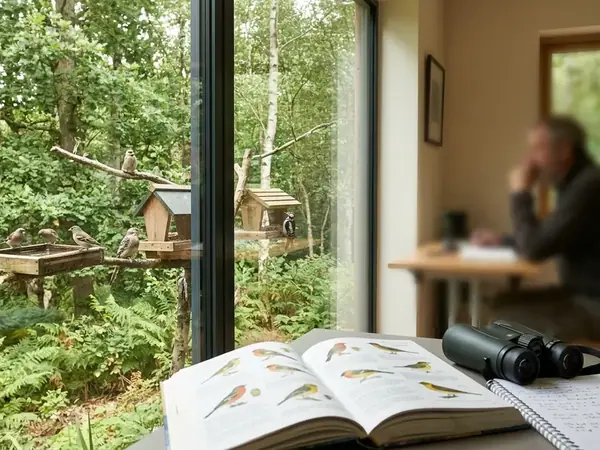
A window feeder creates an unusually close meeting point between birds, food, glass, and household activity. For window birdwatching, that proximity makes subtle behavior easy to see. It also makes interpretation more demanding.
The most reliable approach begins with visible actions rather than presumed motives. Approach, perch, peck, pause, scan, retreat, and displacement provide a workable record of how birds use the feeder and respond to its surroundings.
What It Means for a Window Feeder to Change Behavior
A behavioral change is an observable difference in what a bird does near the feeder. It may approach by a different route, wait on a nearby branch, scan between bites, feed without interruption, retreat after indoor movement, or displace another bird from the perch.
The feeder alters several conditions at once. Food becomes concentrated in a small area. Birds approach a reflective surface, people may be visible at close range, and the available perching space may permit only one or two feeding positions. Each condition can shape what happens during a visit.
For consistent recording, one visit begins when a bird lands on the feeder or its immediate support and ends when it leaves that area. A bird waiting on a nearby branch starts a new visit only when it returns to the feeder. This definition prevents a continuous period nearby from being counted as several feeder visits.
Short-term responses within a single 10-minute watch should remain separate from patterns repeated across days. A sudden retreat during one visit may follow a passing shadow or predator. A similar retreat appearing during three to five comparable watches across several days deserves closer examination. Neither observation, by itself, establishes lasting habituation or harm.
Record Actions First
Write down what the bird does before assigning meaning. “Raises head, freezes, and leaves after a person crosses the room” carries more useful information than “seems nervous.”
What Feeder Observations Can and Cannot Tell Us
Behavioral evidence works in layers. Controlled research can isolate and test a defined variable. Broader feeder monitoring can reveal associations that recur across locations or periods. A household log has a narrower purpose: it can identify a repeated local change and a plausible trigger worth checking.
That distinction matters when traffic rises after a feeder is installed. Concentrated food may explain the increase, though weather, migration, breeding activity, nearby cover, changing natural food supplies, or birds learning the feeder’s location may also contribute. A sudden decline may follow wet food, a predator’s arrival, migration, or activity at another feeder.
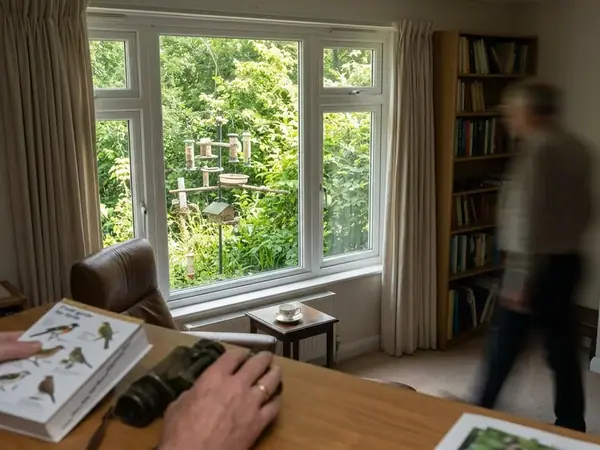
Local comparisons become clearer when watches occur within the same hour-long time-of-day band. The observer should also record whether the room is empty, occupied but quiet, or active. A bird facing movement behind the glass receives a different set of cues from one feeding beside an empty room.
A candidate pattern should appear during at least three comparable observation periods before it is described as recurring. This is a household recording rule rather than a statistical proof threshold. A home log can document repeated behavior and likely triggers at one window, but it cannot establish causation, reveal a bird’s internal emotional state, or support broad conclusions about other species and feeder designs.
Comfort Near the Glass Is Not a Single Behavior
Apparent comfort should be separated into visible components: directness of approach, time on the perch, continuity of feeding, recovery after indoor movement, alarm posture, and the manner of departure. One posture rarely settles the question.
Habituation describes a reduced response after repeated exposure to a stimulus that has presented no threat. At a window feeder, a bird might gradually resume feeding sooner after a seated person shifts position. That response concerns a particular stimulus in a particular setting. It does not show broad comfort with people.
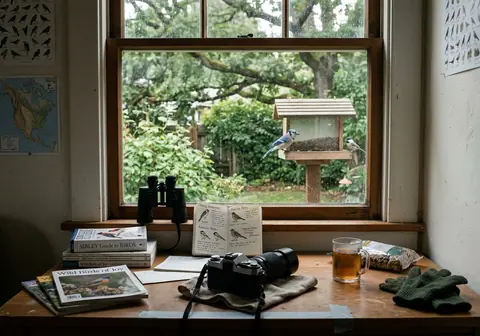
Consider two birds at the same feeder. The first lands, scans once, and continues pecking while a seated observer remains still. The second freezes repeatedly, crouches, turns toward the room, and leaves whenever someone passes. Both birds visit the food, yet their feeding continuity and response to movement differ sharply.
Recovery latency offers a practical comparison. After visible indoor movement, count the seconds until the next peck. Record “departed” if the bird leaves before feeding resumes. Responses can then be compared over roughly four to seven sessions while curtains, indoor lighting, observer position, and pet access remain as consistent as practical.
Watch The Recovery
The moment after a disturbance often carries more information than the initial pause. Note whether feeding resumes, how long recovery takes, and whether the bird changes position before continuing.
Why More Visits Do Not Necessarily Mean Greater Ease
A bird may learn that a window feeder provides a predictable reward and add it to a repeated foraging route. High traffic can therefore reflect successful food finding even when the bird continues to react strongly to people indoors.
A tally-only log obscures this distinction. Ten brief land-and-leave events can appear more positive than two long, uninterrupted feeding bouts. A more useful record pairs arrivals with visit duration and departure context.
- Under 10 seconds: captures brief approaches, rapid seed grabs, and immediate departures.
- 10 to 59 seconds: identifies moderate visits that may include several feeding and scanning cycles.
- At least 1 minute: marks sustained feeder use for comparison with shorter visits.
These duration bands organize a home log; they do not define biological comfort. The observer should compare three to five active periods before and after a change, scheduled within the same time band over a week or so. Birds should be identified only to species unless a stable plumage mark or band is clearly visible.
Context belongs beside the count. Depleted natural foods, harsh weather, migration, nesting demands, fresh seed, and activity at neighboring feeders can all alter traffic. A bird may return repeatedly for concentrated food yet freeze whenever someone crosses the room. Visit count and visit quality answer different questions.
A Small Feeding Platform Can Concentrate Competition
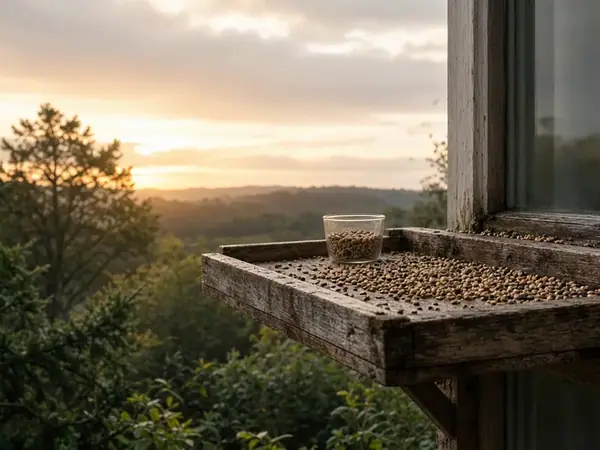
Limited tray space brings birds into close contact. A single usable perch can also create one dominant approach route, unlike scattered natural foraging where individuals can spread among branches, seed heads, or ground patches.
Competition appears through sequences. One bird may wait nearby, lunge, chase, raise its wings, guard the food, grab a seed rapidly, or force another bird from the perch. Count a displacement when one bird’s approach, lunge, wing display, or contact is followed by another bird giving up the feeder within a couple of seconds.
During each 10-minute watch, record the highest number of birds on the tray at the same time, the number waiting within roughly 2 meters, and whether the feeder has one usable perch or several access points. These details help explain why the same species mix may behave differently across feeder designs.
A larger bird occupying the only perch can make smaller species wait nearby. With several access points, the same mix may feed with little direct conflict. Waiting alone should not be coded as aggression, particularly when birds take turns without lunges, displays, contact, or forced departures.
Departure context remains essential. A bird may leave because another bird advances, but it may also react to indoor movement, a predator, or an abrupt sound. Recording the event immediately before departure keeps ordinary turn-taking separate from direct displacement.
Vigilance, Startle Responses, and the Window Itself
Vigilance includes visible actions such as head-up scanning, pauses between bites, orientation toward cover, alarm calls, and sudden retreat. Scanning is a normal part of feeding. Its trigger, frequency, and outcome provide the useful comparison.
Tally one scanning event each time feeding stops and the bird raises or turns its head. Begin a new event only after pecking has resumed. A head-up pause followed by ordinary feeding can then be distinguished from a freeze, alarm call, abrupt retreat, or uncontrolled flight toward the pane.
The feeder presents competing cues: nearby food, reflected sky or vegetation, people moving inside, predators passing outdoors, and escape cover at varying distances. Changes in any one of these cues can alter vigilance. For example, repeated head turns toward the room during household activity point to a different trigger than simultaneous alarm calls and retreat toward dense cover.
Inspect Every Contact
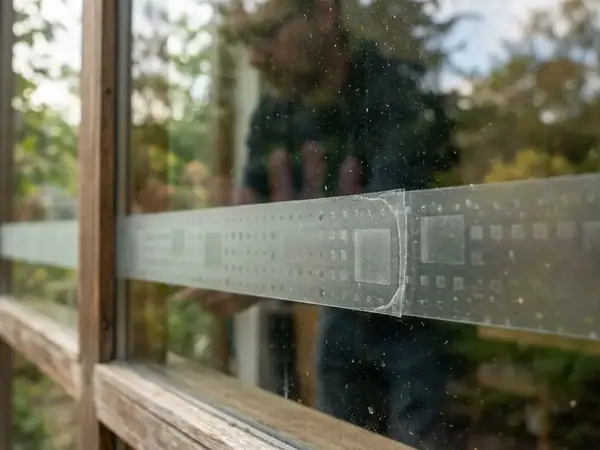
Record any glass contact immediately, including the pane involved, flight direction, visible reflection, indoor lighting, and outcome. Even one strike or repeated tapping calls for an inspection before backyard bird feeding resumes.
Feeder care and safety extend beyond fresh food and clean surfaces. Reflections, approach paths, and nearby escape cover belong in the same observation record because the window itself forms part of the feeding site.
Run a Respectful Observe–Adjust–Recheck Routine
A compact field routine can turn casual window birdwatching into a careful local comparison. The method preserves an unchanged baseline, alters one relevant condition, and checks whether the same behavior continues.
- Establish the baseline. Complete 3 sessions of 10 uninterrupted minutes within 3 to 7 days.
- Keep the viewpoint stable. Watch from the same indoor seat and use the same hour-long time-of-day band.
- Use fixed categories. Record date, start time, weather, species, arrivals, visit durations, scanning events, startles, displacements, indoor movements, predators, and window contacts.
- Change one condition. Adjust a plausible factor such as bright indoor movement, curtain position, lighting, pet access, or a congested approach route.
- Recheck under comparable conditions. Complete 3 comparison sessions during the following 3 to 7 days.
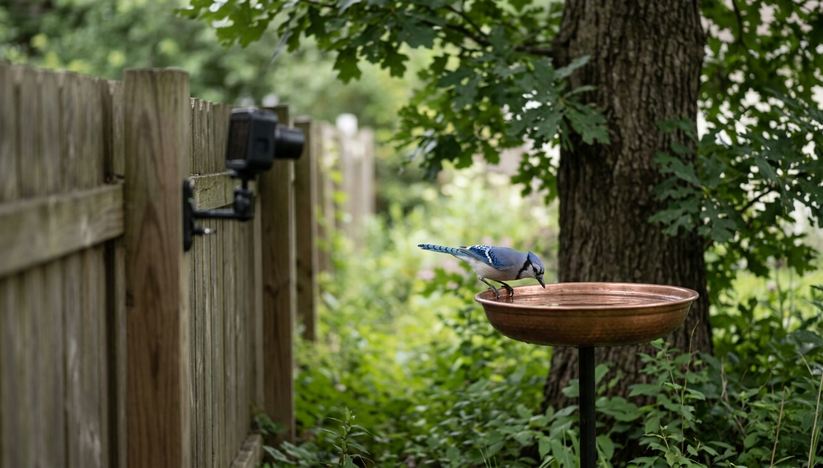
Suppose repeated departures occur when someone crosses a brightly lit room. The household first records 3 baseline watches without changing the setup. It then reduces movement near the window during active feeding periods while leaving the feeder, food, curtains, and observer position unchanged. Three comparison watches reveal whether abrupt departures become less frequent and whether feeding resumes sooner after the remaining movements.
The routine also protects birds from constant tinkering. Changing food, perch access, curtains, lighting, and observer position together would leave the cause of any response unclear. One measured adjustment provides a cleaner comparison and supports a calmer bird-friendly habitat.
At the next active feeding period, sit in one fixed position and record every arrival, visit duration, scan, startle, displacement, indoor movement, predator, and window contact for exactly 10 minutes before altering the feeder.