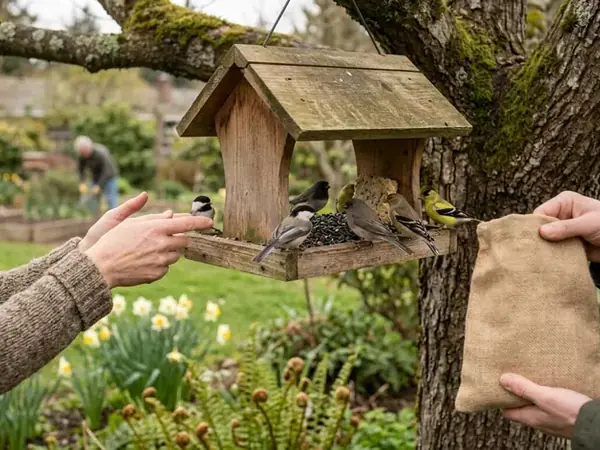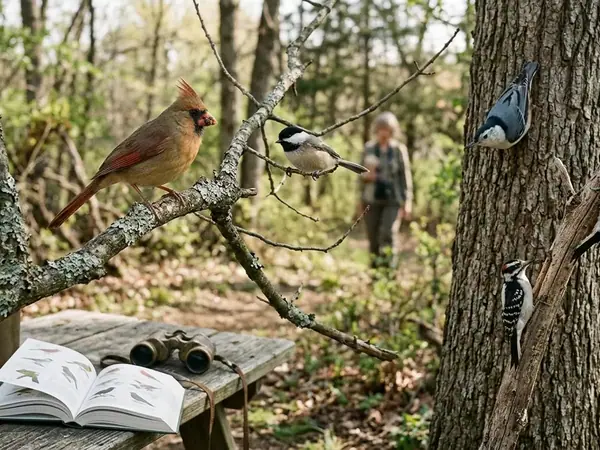
A busy feeding station can look chaotic: one bird waits in a shrub, another leans across a tray, and a third departs before the newcomer lands. Careful observation reveals more structure. Much of it comes down to tracking access to specific food, perches and feeding ports rather than assigning a permanent reputation to an entire species.
Reading Rank at the Feeder
A feeder pecking order is a recurring pattern in which individual birds gain, yield or defend access to a resource. That resource may be a tube port, tray edge, seed patch or waiting perch. Each should be treated separately because a bird may surrender one location while continuing to feed at another.
The order can appear surprisingly quiet. A waiting bird may remain on a nearby branch until a port opens. Another may raise its feathers, lean forward or approach closely enough that the occupant leaves. Pursuit and physical fighting sit at the conspicuous end of a much broader range of behavior.
Repetition Establishes the Pattern
One abrupt departure provides little evidence by itself. The feeding bird may have taken a seed to cover, reacted to a sound or finished its visit. A useful record begins with three questions:
- Which bird approached?
- Which bird yielded?
- What exact resource was occupied?
Watch through at least five approach-and-response interactions before describing a recurring winner and yielder. Even then, keep the conclusion narrow. A bird that controls the near corner of a sunflower tray may have no influence over a tube port a few wingbeats away.
Name the Resource
Record “left tube port” or “near tray corner” rather than “the feeder.” Precise location notes prevent a local dispute from becoming an exaggerated claim about the whole station.
Five Steps from Waiting to Contact
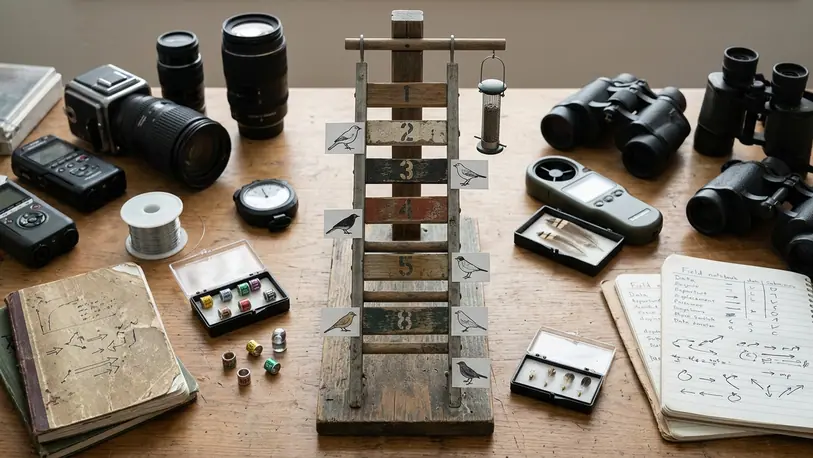
Encounters become easier to compare when they are classified by what ends the interaction. The resulting ladder moves from waiting to posturing, displacement, a short chase and sustained contact.
Waiting and Display
Waiting requires no intervention from the bird already feeding. The waiting bird stays on an unused perch, branch, railing or shrub until access becomes available. A visible queue can form when several birds use the same staging point.
Posturing relies on display. Record an open bill, raised crown or body feathers, sideways presentation, forward lean and wing flick as separate cues. Turning sideways can make a bird appear larger, while a forward lean directs the display toward a particular neighbor. These details matter because a quick feather raise carries different weight from repeated physical contact.
Departure, Pursuit and Fighting
Displacement occurs when one bird leaves a port, tray or perch as another approaches, even if the two never touch. It is one of the clearest feeder-ranking signals because the approach directly changes access to food.
A short chase ends after the displaced bird leaves the feeder or its nearest staging perch. Repeated loops among feeders, shrubs or railings indicate a more serious encounter. Sustained contact continues after escape becomes available and can include pinning, persistent pecking or grappling.
Stop for Injury
Pause use of the problem feeder immediately after pinning, sustained pecking, grappling or a visible injury. Seek guidance from a licensed wildlife rehabilitator before attempting to handle an injured wild bird.
Record the Actor, Yielder and Contested Spot
Species reputation and body size can distract from the encounter taking place. Start with a three-part record: approaching bird, yielding bird and occupied resource. Identification can then be added at the level the view supports.
If individuals cannot be distinguished confidently, write “a male Northern Cardinal” rather than “the same male cardinal.” Plumage similarities, brief visits and obstructed views can make individual identification uncertain. The observation remains useful when its wording reflects that uncertainty.
The Five-Interaction Feeder Check
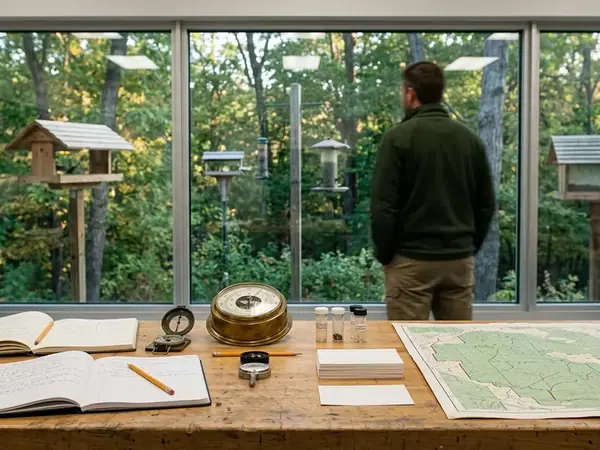
For each of five encounters, log the following fields in the same order:
- Approaching bird: identify the individual when possible, or use the narrowest reliable description.
- Yielding bird: note who moved away, changed ports or left the station.
- Contested resource: specify the left tube port, near tray corner, platform center, ground patch or branch above the station.
- Highest behavior observed: waiting, posturing, displacement, short chase or sustained contact.
- End point: record whether the encounter stopped at the feeder, nearest staging perch or farther into the yard.
Next, look for direction. Does one bird repeatedly approach while another yields? Does the direction reverse later? Is the interaction restricted to a tray corner, or does the approaching bird follow its neighbor across the station?
Size Is Only One Variable
Body size can influence a close encounter, yet it does not establish a universal ranking. Persistence, flock behavior and familiarity with the feeder also shape access. Several birds may pressure a solitary visitor through repeated approaches even when no single encounter looks severe.
A Northern Cardinal that displaces a House Finch from a sunflower tray illustrates the value of resource-level notes. If the cardinal remains on the tray and allows finches to use separate tube-feeder ports, the evidence supports control of the tray. It does not support control of the entire feeding station.
Seasons and Crowds Rewrite the Ranking
Feeder order shifts with the current crowd, food supply and station geometry. Breeding birds may defend access differently from winter flock members. Recently fledged birds may hesitate near adults, crowd them or misread displays that experienced birds respond to quickly.
Compare Like Feeding Periods
Timing affects what appears at the window. Compare observations made during the same 15- to 20-minute part of the feeding routine rather than combining a quiet midday visit with a crowded morning period. A larger flock can create a visible queue, increase rapid turnover or allow several individuals to pressure a solitary bird.
Food concentration matters as well. Scarce or especially favored seed draws attention to a small area. Adding more seed to the same tray may leave the access problem unchanged because every bird still has to reach one surface.
Map the nearby staging points within one direct flight of the station. Branches, fence tops, shrubs and railings may allow a bird to watch more than one feeder from a single position. That lookout can become as important as the feeder itself.
Keep Rankings Local
A ranking recorded at one yard, feeder design or season should not be extended to the species as a permanent social order.
Redesign the Bottleneck, Not the Yard
When one bird repeatedly controls access, begin with the repeated bottleneck. Duplicate the favored food at a second feeding point rather than replacing the entire station. This preserves the feature attracting the birds while testing whether access improves.
Separate the Guarded Points
Distance alone may accomplish little when a bird can monitor both feeders from the same branch. Increase separation and break the direct line of sight with existing vegetation, a corner of the building or another suitable visual barrier. Remove a lookout perch only when repeated records connect that perch with control of both feeding points.
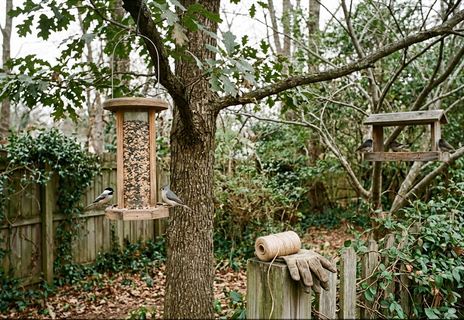
Access points can also be matched to feeding styles. A tube feeder with several ports allows turnover among small perching birds. A platform or hopper offers a different landing surface, while a separate ground-feeding area distributes activity vertically and horizontally. The useful combination depends on where the recorded conflict occurs.
Change One Feature at a Time
Keep the food constant for three comparable busy feeding periods after changing spacing or feeder type. Altering seed and layout together obscures the cause: improved access could result from the new position, lower interest in the replacement seed or both.
Occasional posturing does not make a layout change ineffective. The stronger test is whether displaced birds can reach the same favored food through an alternate route and whether chases stop near the original feeding point.
Test the Sunflower Tray at the Next Rush
Consider a station where one Northern Cardinal repeatedly clears House Finches from a sunflower tray. Nearby tube-feeder ports remain lightly used, and the cardinal does not leave the tray to challenge finches at those ports.
The pattern identifies the tray and its sunflower seed as the bottleneck. Adding an unrelated food would test a different preference. Moving every feeder would change several variables at once and make the next observation difficult to interpret.
A Controlled Layout Change
Before altering the station, record five encounters during one busy feeding period. For each, note the approaching bird, yielding bird, contested resource, highest behavior and where the encounter ended. This establishes whether the cardinal consistently clears the tray or whether the apparent pattern came from a few unrelated departures.
Then place the same favored sunflower seed at a second feeding point beyond the cardinal’s immediate view. Leave the other feeders and foods unchanged. During a comparable 15- to 20-minute feeding period, watch whether displaced finches reach the second serving and whether the cardinal attempts to guard both locations.
The result may refine the original interpretation. Continued tray displacement alongside successful feeding at the second point indicates that the alternate route is working, even if the cardinal still postures. Movement between both servings would direct attention toward the lookout position and line of sight.
At the next busy feeding period, record five approach-and-response encounters before placing a second serving of the favored food outside the guarding bird’s direct view.