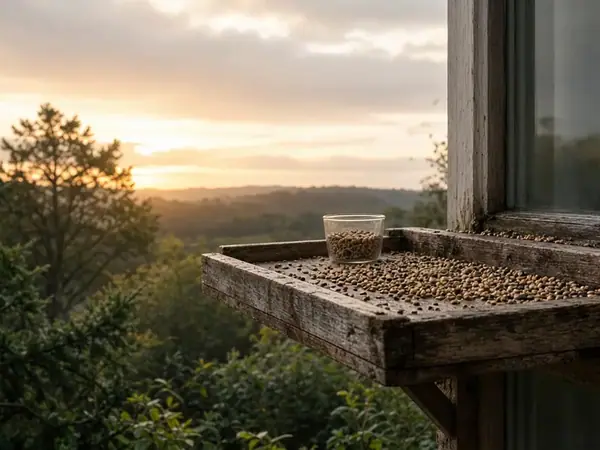
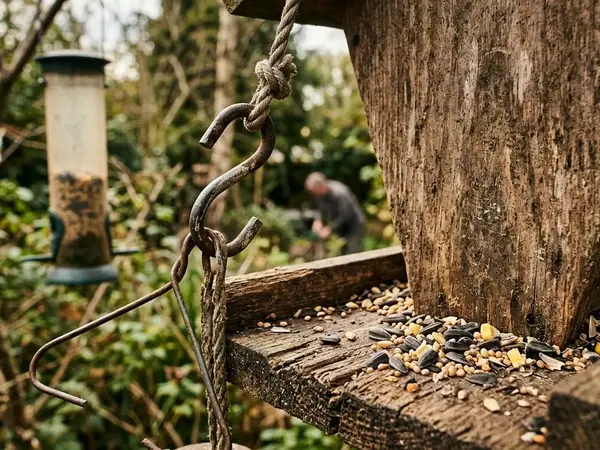
Backyard bird feeding grew out of place-based seasonal routines. Observers watched which winter visitors arrived at kitchen windows and porch railings, adjusted their seed mixes to match local weather, and shared their findings with fellow birdwatchers. As these birding community notes circulated across broader print and digital networks, practical routines detached from the specific habitats and seasonal conditions that shaped them. A situated observation from one yard gradually began to read like a universal rule for every yard.
Consider the familiar recommendation to keep a feeder stocked through winter. That single phrase often travels much farther than the original yard's weather patterns, surrounding wildlife community, and local wildlife-attractant instructions. A winter-feeding recommendation requires more than a season name to be responsible; it requires identifying the locality, the non-target wildlife likely to reach the food, and any relevant feeding restrictions. When someone reports that birds visited a station throughout the colder months, that account documents feeder use, whereas permission or appropriateness depends on local conditions and rules.
Useful backyard bird feeding advice names where it applies and separates personal yard observations from current official guidance. Grounding every tip in its specific regional context protects both visiting flocks and the surrounding bird-friendly habitat.
How Habitat Zones and Weather Shape Feeder Decisions
Defining the relevant region for a feeding station depends on the specific decision being made, rather than defaulting to an entire country or state. Municipal ordinances may govern whether a station is permitted on a property, a state or provincial wildlife-management area may define the boundaries of a temporary advisory, and a localized habitat zone often explains daily exposure to moisture or visiting mammals.
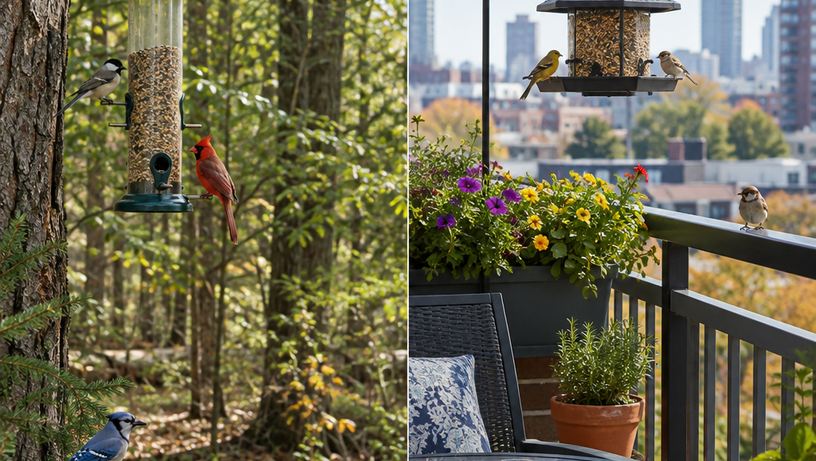
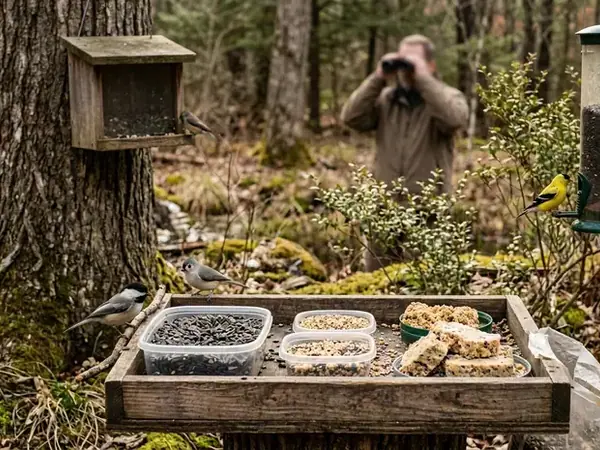
Comparing a wooded yard where bears may occur with an urban high-rise balcony illustrates how physical context alters feeder care & safety. Neither setting is automatically problem-free; each presents distinct management demands:
- Wooded yards with mammal access: Evaluators must assess whether birdseed, suet, hull accumulation, or stored supplies could attract wildlife other than birds. Ground-level spills and accessible storage sheds become primary management points.
- Urban balconies: The inspection focus shifts to the feeder tray, the balcony floor, and the architectural ledges or neighboring spaces below where discarded seed hulls and droppings can accumulate.
Local weather patterns further separate one region's maintenance routine from another's. Persistent rain wets feeding ports and open trays, while high ambient humidity slows drying between storms. In colder zones, freezing conditions can lock wet residue in place inside tubes and hoppers. Conversely, seasonal heat makes retained moisture and rapid food spoilage critical inspection points. Rather than relying on a fixed refill calendar, observers should inspect the actual condition of the food and equipment before adding fresh seed.
Context Checklist for Feeder Notes
When recording or evaluating window birdwatching notes, verify six core details: locality, season, habitat description, feeder type, food offered, and the date official guidance was checked.
Where backyard bird feeding records document steady flock arrivals, the finding establishes only that birds are accessing the food. Their presence at a perch does not answer whether maintaining that station is appropriate under current local instructions.
Verifying Current Local Guidance Before You Refill
Before adopting a tip found online or in a general handbook, run an ordered verification process. First, identify the wildlife agency responsible for the feeder's specific location. Read its current bird-feeding or wildlife-attractant guidance, then check municipal codes and any applicable public-health advisories.
Targeted search phrases help locate the relevant agency pages quickly:
- [region] bird feeder advisory
- [municipality] wildlife attractant rules
- [region] sick wild birds reporting
Treat search engine snippets as starting points rather than complete instructions. Open the official government or agency page directly to evaluate the document's authority, geographic coverage, and timing. For each notice, record five distinct elements: the issuing authority, the exact geographic area covered, the publication or update date, the stated effective period, and whether the text supersedes an earlier notice. Keep in mind that a webpage's technical update date and a wildlife notice's effective seasonal period are separate details.
While an exact street address is useful privately to confirm which municipal or wildlife-management jurisdiction applies, keep home addresses out of public feeder logs. A notice issued for a neighboring county or adjacent management zone can prompt closer checking, even if it does not directly govern the reader's yard.
When reviewing agency pages, preserve the exact legal and practical distinctions in the source text. A municipal legal restriction, an agency recommendation, and an experienced birder's personal preference carry different weights. Describe each according to the source's actual wording rather than converting every cautious recommendation into an absolute prohibition. If overlapping documents conflict or lack clear dates, contact the responsible authority with a focused question: "Does this feeder guidance cover my locality, and is it still in effect?"
Evaluating Attractant Rules in Bear Country
Advice focused solely on feeder height, perch spacing, and bird identification & behavior is incomplete whenever non-target wildlife may be drawn to the calorie source. In regions where bears occur, evaluate birdseed and suet as general wildlife attractants before considering how easily chickadees or finches can reach the ports.
Local bear-management guidance typically specifies whether birdseed, hummingbird nectar, and suet cakes fall under attractant definitions. Review the text to see whether restrictions apply seasonally or year-round, and whether the rules address spilled food on the ground and bulk seed stored in garages, sheds, or porch bins. Bear activity and feeder requirements vary by locality and season, so use the applicable local instructions rather than supplying a universal removal calendar.
Removal Rules Override Hardware Adjustments
Distinguish a rule or advisory calling for complete feeder removal from general tips aimed at reducing wildlife access. When an applicable instruction calls for taking feeders down, a tall pole, a pole-mounted baffle, or an evening bring-in routine does not override that requirement.
When removal is required or recommended for your area, take the feeding hardware down promptly, clear any hull buildup or spilled seed beneath the mounting site, and transfer bulk food supplies into secure indoor storage according to local instructions. Simply unhooking a tube feeder leaves the job incomplete if fallen sunflower seeds remain scattered across the lawn.
Managing Wet Seed and Wildlife Health Advisories
Refilling a station should function as a physical condition check rather than an automatic chore. Before pouring new seed into a hopper, inspect the remaining food, the feeding surfaces, and any accumulated waste around the ports. Damp or clumped seed, wet food sitting in an open tray, hulls matted with droppings, and equipment that fails to dry between rain showers all require immediate cleanup rather than a top-off.
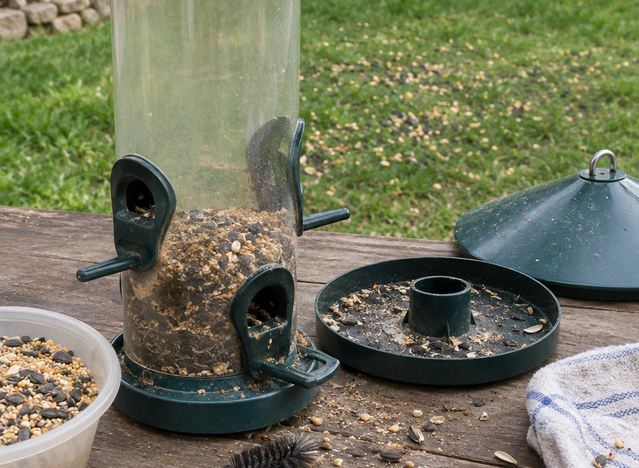
Where routine equipment inspections reveal clumped seed or fouled ports, those observations identify a localized maintenance problem rather than a veterinary diagnosis. However, if visiting birds show signs of illness or if a regional wildlife-health advisory is in effect, consult the responsible wildlife agency's specific directions regarding feeding pauses, equipment cleaning, and observation reporting.
Keep ordinary feeder care & safety distinct from outbreak-specific agency protocols. Different pathogens and regional outbreaks require different responses, so rely on the issuing authority's current instructions rather than applying a generic closure timeframe or an unverified cleaning formula. Visual checks of the yard have limits: an apparently healthy flock visiting a window feeder does not rule out a broader regional advisory, and a single disheveled or lethargic bird does not, by appearance alone, establish a specific disease diagnosis.
Documenting Official Advisories
When checking local health or attractant notices, save the official webpage link, the notice's issue or update date, its stated effective period, and the exact date you reviewed it. Saving a screenshot preserves what was displayed at that moment, though you should always revisit the live source page before treating an older screenshot as current advice.
Sharing Located Feeder Observations With Your Community
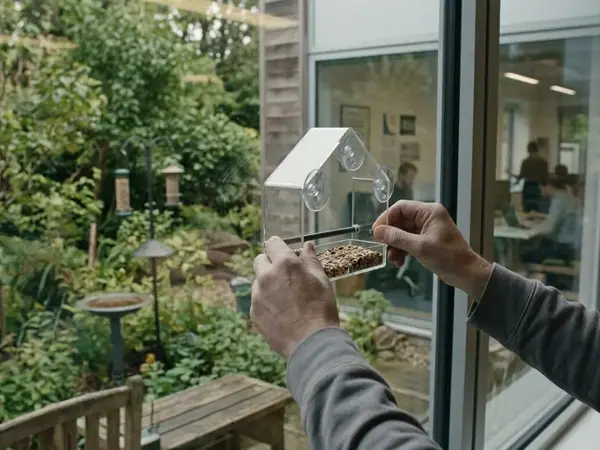
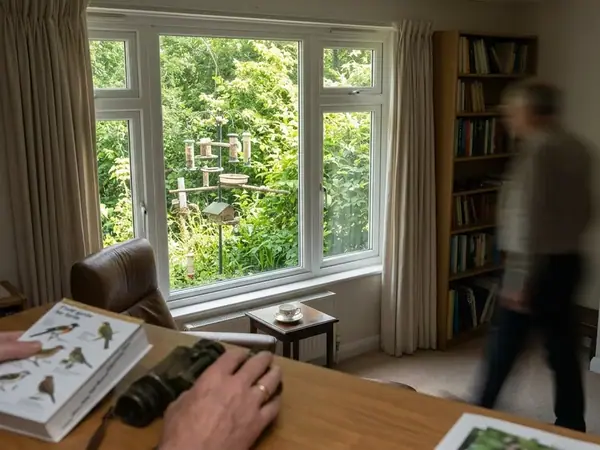
When sharing window birdwatching notes or equipment reviews with neighbors and online groups, build the tip from the concrete observation outward. State the place and season first, describe the feeder style and food offered, and then state what actually occurred. Attach the official guidance you checked—and the date you checked it—as a separate, verifiable layer.
Use this structure to keep shared tips grounded:
"In [locality], during [season and year], I observed [specific result] at a [feeder type] using [food]. I checked [responsible authority's guidance] on [date]."
For public forums, identify the location using a town, county, or broad habitat description rather than a residential street address or exact coordinates. Likewise, replace broad claims of universal success—such as asserting that a particular tray design works everywhere—with bounded accounts drawn from actual yard notes: "At this window feeder in [locality], [observed birds] used [food] during [recorded conditions]."
In my own seasonal logbooks, separating three distinct categories of information prevents confusion when reviewing past seasons:
- What was directly observed: The species present, the food consumed, and the weather conditions at the feeder.
- What the authority recommends: The specific municipal rules or wildlife agency advisories active for that locality on the date checked.
- What remains unknown: Unmeasured outcomes. Visits recorded at one backyard station do not establish regional disease status, guarantee safety for neighboring yards with different predator or mammal pressures, or confirm compliance with rules that may have changed since the log entry was written.
Attach Context to Every Photo
Share the locality, date, and weather conditions alongside your feeding tip—never rely on a photograph of a crowded feeder alone to carry the recommendation.
Testing a Feeding Tip Against a Local Notice
To see how these verification steps work in practice, consider an explicitly hypothetical scenario. Suppose a homeowner reads an undated social media post praising year-round suet and black-oil sunflower feeding for keeping woodpeckers and nuthatches close to the house. Before buying bulk seed, the homeowner searches for their state wildlife agency's current attractant page and locates an active seasonal notice advising residents in their specific management zone to remove bird feeders due to spring and summer bear activity.
The decision then unfolds in a clear sequence:
- Verify jurisdiction and timing: The homeowner checks the notice's geographic boundary map and effective dates, confirming that the advisory covers their residential address and the current month.
- Follow removal and attractant instructions: Rather than trying to modify the setup with a higher pole or taking the tube in only at night, the homeowner takes the feeder down completely, rakes up leftover hull debris beneath the mounting post, and moves extra seed bags into a latched indoor utility room.
- Retain the source and pause sharing: The homeowner bookmarks the official agency notice with the date checked and refrains from reposting the undated year-round feeding tip as current local advice.
Before your next refill, check the current notice from the wildlife authority and municipality governing your yard, then attach your locality and check date to any birding community notes you share afterward. If your favorite feeding tip conflicts with today's guidance for your locality, will you refill the feeder or change the plan?