What field marks reveal at a backyard feeder
A red breast, a small patch at the back of the head, a black forehead: each can help distinguish male and female feeder birds. Each also needs the right context.
Field marks are visible features used to identify birds, including plumage patches, streaks, bill shape, and wing patterns. Some help establish the species. Others can also support a sex assessment. Sexing means identifying a bird’s biological sex from observable evidence; recognizing its species is a separate decision.
For familiar North American feeder visitors, three species offer useful comparisons. House finches direct attention to colored areas on the head and breast. Downy woodpeckers require a look at the nape. American goldfinches bring seasonal plumage into the decision.
The practical aim is a defensible observation. Age, season, and an incomplete view can leave a correctly identified bird’s sex undetermined.
Identify the bird before judging its color
A repeatable sequence keeps window birdwatching from becoming a rush to label the brightest visitor.
- Establish the species. Compare shape, bill, size, and plumage pattern together.
- Find the relevant patch. Locate the forehead and breast on a house finch, the nape on a downy woodpecker, or the forehead and body plumage on an American goldfinch.
- Consider age and season. Decide whether the visible plumage supports the proposed male or female assessment.
Feeder position determines what evidence becomes available. A front-facing finch exposes its upper breast, while a downy woodpecker turning sideways and away may reveal its nape. A feeder roof can hide the finch’s forehead. Even a woodpecker facing away may tuck its head enough to conceal part of the relevant patch.
Hidden Napes Stay Unresolved
“Nape hidden” and “entire nape visible, no red seen” describe different observations. Only the second documents the absence of visible red across the relevant area.
Light deserves a check, too. Warm sunlight, tinted glass, and camera adjustments can shift apparent hues. Patch location and pattern offer firmer ground than a subtle red-versus-orange distinction. Watch through several natural turns without tapping the window, approaching the feeder, or using playback to obtain a preferred angle.
House finches: colored head and breast versus plain streaking
On a confirmed house finch, the characteristic colored forehead and upper breast support a male identification. The exact shade can vary.
Adult males typically carry red, orange, or yellow on the forehead, eyebrow region, upper breast, and rump. Brown streaking remains elsewhere, particularly along the flanks. A yellow-toned male can therefore carry useful evidence in the same places as a red-toned male.
Adult females are brown and streaked, without that colorful head-and-breast pattern. Young males can initially resemble females, however, so a plain, streaked bird may be female or immature.
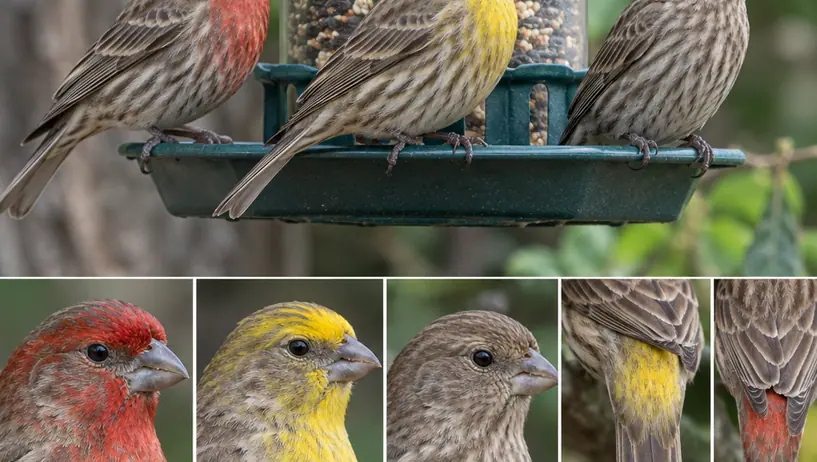
The comparison works best when the record preserves both parts:
- Colored forehead and upper breast: supports male when the species and patch placement are clear.
- Plain brown head and streaked breast: consistent with female or immature plumage; age remains unresolved.
Before labeling a reddish finch, check the species again. Male purple finches generally show more extensive raspberry-colored plumage. Female-type purple finches often have a stronger pale eyebrow and a more contrasting face. Those features belong alongside underpart streaking in the identification, rather than letting redness make the decision alone.
Downy woodpeckers: check the back of the head
At a suet feeder, the useful moment often comes with a side-to-rear head turn. That angle can expose the small red patch carried by an adult male downy woodpecker.
First, confirm downy. Its short bill is distinctly shorter than the depth of its head. A hairy woodpecker has a much more substantial bill, approaching head length, despite a similar black-and-white pattern. Feeder position can make size judgments awkward, so bill proportions deserve attention.
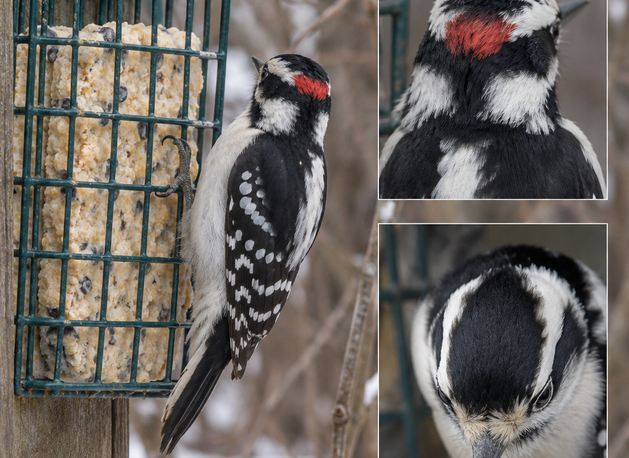
Adult males have a red patch on the back of the head; adult females lack it. For a female assessment, the observer needs a clear view of the entire relevant area on an adult. A fleeting impression of a black-and-white head supplies weaker evidence.
Red on top of the head requires another check. Juvenile downy woodpeckers can show red on the crown. Recording “crown” or “nape” preserves the distinction that a loose note such as “red head” loses.
A brief visit with a clear nape view can be more useful than a long visit with that area concealed. The quality of the angle carries the decision.
American goldfinches: season changes the comparison
A breeding-plumage adult male American goldfinch offers a strong combination: bright yellow body, contrasting black forehead, and black wings with pale wing bars. The breeding-season adult female is generally duller yellow or olive and lacks the male’s bold black forehead.
Brightness alone is a weaker comparison.
Outside breeding plumage, adult males become much more subdued and resemble females more closely. Juveniles add further muted appearances. A subdued goldfinch without a bold black forehead therefore cannot be assigned female simply by reversing the breeding-male description.
- Clear adult breeding plumage: the combined bright yellow body and bold black forehead support male.
- Subdued nonbreeding plumage: muted color and no bold black forehead leave male and female possibilities open.
- Uncertain age: record body color, forehead pattern, and wing bars before attempting a sex assessment.
The date helps frame the observation, but it does not settle it. Progression into and out of breeding plumage varies geographically and among individuals. A universal calendar cutoff would give the date more weight than the bird’s visible features.
Keep the visible mark separate from your bird label
Useful birding community notes let another observer follow the reasoning. “Male” records a conclusion. “Red patch on nape” records the evidence behind that conclusion for an adult downy woodpecker.
This notebook format keeps both available for review:
Date: [observation date]; species: [identification]; viewing angle: [angle]; visible marks: [features actually seen]; age clues: [if evident]; sex assessment: [male, female, or undetermined].
An illustrative entry might read: “Date: [observation date]; downy woodpecker; side-to-rear view; red patch on nape, crown visible; adult appearance; male.” This is a model entry, rather than a reported sighting.
Chickadees provide a useful boundary for the method. Males and females look very similar, and an ordinary feeder view generally does not establish sex. Larger size, dominance at the feeder, or two birds feeding together also cannot serve as stand-alone evidence of male sex or a male–female pair.
For backyard bird feeding records, “sex undetermined” preserves what the observation actually supports. It leaves a clean record for later discussion without forcing every visitor into a male or female label.
Work through a muted goldfinch at the seed feeder
Consider a hypothetical winter visit. A small, subdued finch arrives at a seed feeder. It has a conical bill and blackish wings bearing pale bars. The observer follows the same sequence from identification to written record.
- Establish the species. Compare size, shape, bill, and wing and body patterns together. In this example, the full combination supports American goldfinch. If those features remain unclear in another sighting, record “species unresolved”; lack of bright yellow cannot establish the species.
- Inspect the forehead and body. Watch through several natural turns in neutral light. Here, the views confirm subdued body plumage and no bold black forehead.
- Apply the seasonal comparison. That appearance fits winter plumage. A nonbreeding male can also lack the conspicuous breeding-male pattern, so the evidence leaves sex undetermined.
- Write the complete entry. Add the actual date and observed angle to: “Winter visit; American goldfinch; subdued body color, pale wing bars, forehead without a bold black patch; age clues not established; sex undetermined.”
- Start a fresh entry at the next visit. Unless the individual is genuinely recognizable, treat a later goldfinch as a new observation. A bright bird appearing months later receives its own date, visible marks, and assessment.